
Beyond Reality: Dreams, Consciousness, and the Possibility That We Are More Than We Perceive
By Anshul Bohre | Cloud 82
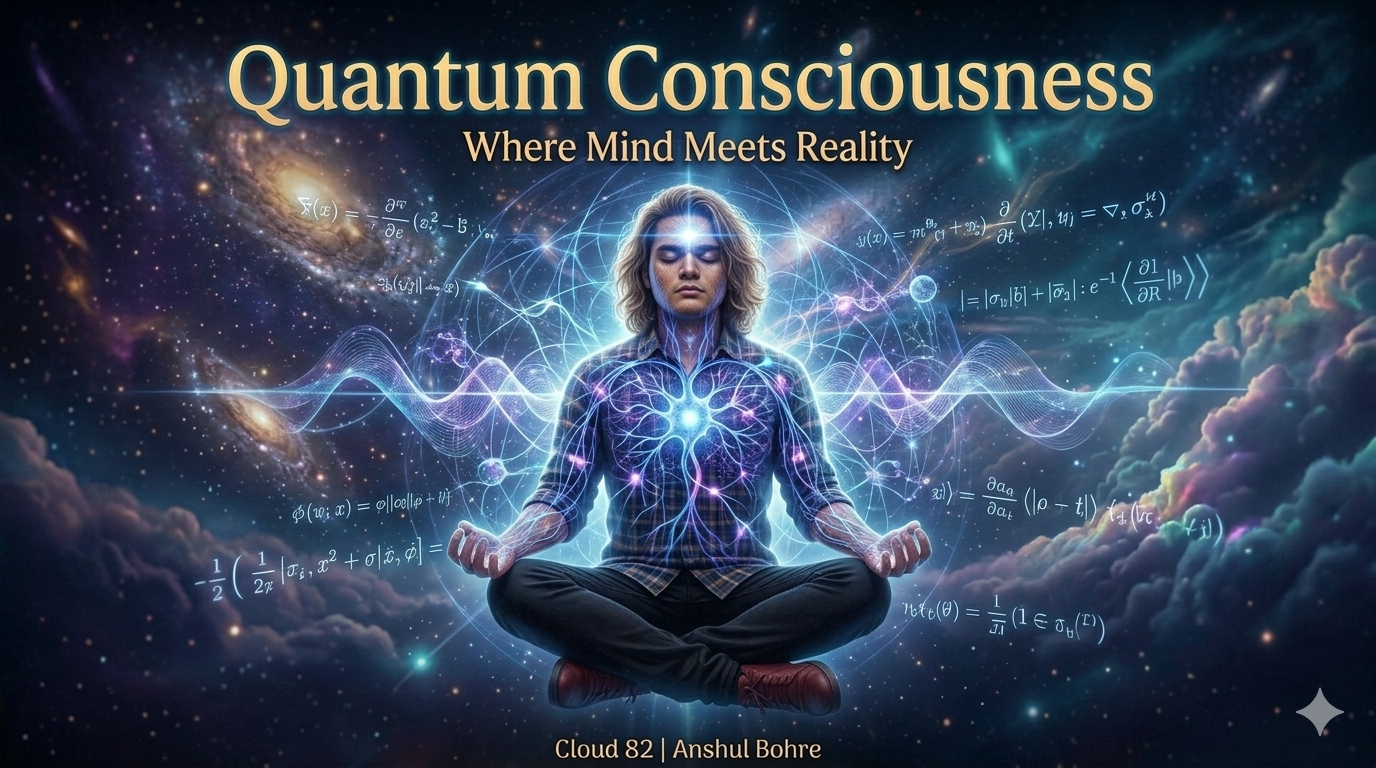
Where Does Reality End—and Consciousness Begin?
There are moments—often in dreams, deep silence, or heightened awareness—when reality feels negotiable. The boundaries soften. Time distorts. Identity blurs.
You wake up and wonder:
Was that just a dream… or did I briefly exist somewhere else?
At Cloud 82, we don’t dismiss such questions—we explore them. Not through fantasy, but through a disciplined curiosity that bridges science, philosophy, and lived experience.
This article navigates three powerful frontiers:
- Quantum interpretations of consciousness (without drifting into pseudoscience)
- Lucid dreaming and the architecture of dream control
- Philosophical frameworks like simulation theory and non-dual awareness
Let’s move carefully—but boldly.
1. Consciousness and Quantum Reality: Where Science Draws the Line
The intersection of consciousness and quantum mechanics is one of the most misunderstood territories in modern thought.
At its core, Quantum Mechanics describes reality at the smallest scales—particles behaving in probabilistic, non-deterministic ways. Concepts like wave-particle duality and observer effects often tempt people to conclude:
“Consciousness creates reality.”
This is where precision matters.
What science actually supports:
- Quantum systems exist in probabilistic states until measured.
- Measurement affects the system—but measurement does not require human consciousness.
- No empirical evidence shows that thoughts alone collapse quantum states.
What remains open:
Fields like Consciousness Studies continue to explore whether consciousness is:
- A product of the brain
- A fundamental property of the universe
- Or something we don’t yet have the language to define
Cloud 82 Perspective
Think of consciousness not as a mystical force bending atoms—but as a lens through which reality becomes meaningful.
You are not collapsing the universe into existence.
But without you—there is no experience of it.
2. Dreams: Not Another World, But a Perfect Simulation
Every night, your mind constructs entire universes—complete with landscapes, characters, emotions, and narratives.
From a neuroscientific standpoint:
- Dreams are internally generated simulations
- Sensory input is reduced, while imagination becomes dominant
- The brain creates a self-contained reality loop
And here’s the striking part:
While dreaming, you rarely question its reality.
This makes dreaming the closest natural analogy to what philosophers call a simulated reality.
3. Lucid Dreaming: When the Dreamer Wakes Inside the Dream
Lucid dreaming occurs when you become aware that you are dreaming—while still inside the dream.
This shifts your role:
- From participant → to observer → to creator
What becomes possible:
- Altering environments
- Defying physical laws (flying, teleporting)
- Confronting fears or exploring subconscious patterns
Lucid dreaming is not mystical—it is trainable.
Techniques include:
- Reality checks (questioning your environment during the day)
- Dream journaling
- Wake-induced lucid dreaming (WILD)
Why it matters
Lucid dreaming demonstrates something profound:
Reality, as experienced, is editable—under certain conditions.
This doesn’t mean waking reality is a dream.
But it does prove that the mind can generate experiences indistinguishable from reality.
4. Simulation Theory: Are We Inside a Construct?
Simulation theory, popularized by thinkers like Nick Bostrom, proposes that advanced civilizations could simulate entire universes—including conscious beings within them.
The argument is probabilistic:
- If simulations are possible, and
- If they are created in large numbers
Then statistically, it becomes more likely we are inside one than in a base reality.
Important clarification:
This is not proven—it is a philosophical hypothesis, not a scientific conclusion.
Why it resonates
Because your brain already does something similar:
- It constructs a model of reality based on limited sensory data
- What you perceive is not reality itself—but a representation
5. Non-Dual Awareness: Dissolving the Observer and the Observed
Now we step into philosophy—not speculation, but direct inquiry into experience.
Non-dual traditions suggest:
The separation between “you” and “reality” is an illusion.
In frameworks influenced by Advaita Vedanta:
- There is no independent observer
- There is only awareness, experiencing itself
This isn’t a belief—it’s something practitioners attempt to directly realize through meditation and introspection.
What this changes:
- You are not “in” reality
- You are not separate from it
- You are the field in which experience appears
6. So—What Are We, Really?
Let’s integrate everything with clarity:
- You are not traveling to other dimensions in dreams
- You are not accessing the future
- You are not literally plasma energy
But you are:
- A biological system generating conscious experience
- A predictive mind simulating reality continuously
- A temporary yet complex pattern of energy and information
- A witness to experiences that feel real—whether waking or dreaming
And perhaps most importantly:
You are the only place where reality becomes known.
Cloud 82 Closing Reflection

At Cloud 82, we don’t rush to label reality as illusion or certainty.
We stand at the edge—where science remains honest, and wonder remains alive.
Because whether this is:
- A universe
- A simulation
- A field of consciousness
One truth remains unchanged:
✨ Your experience is real to you.
And within that experience lies your greatest power—
Not to escape reality…But to explore it more deeply than most ever dare.
https://anshulbohre.com/

The Social Mirror — Social Media, Self-Worth & Digital Wellbeing

Astral Projection: The Science of Out-of-Body Experiences, Dreams & Consciousness

Dreams, Lucid Dreaming & Parallel Universes: Can Consciousness Travel Across Dimensions?

Humanitarian Governance: Reimagining Democracy for Five Generations

Equinox: The Art of Balance
