
The Human Republic 🌍 Reimagining Democracy for Five Generations
By Anshul Bohre | Cloud 82
Cloud 82 — Designed for Depth.
A New Social Contract for a Multigenerational World
We are living through one of the most extraordinary transitions in human history.
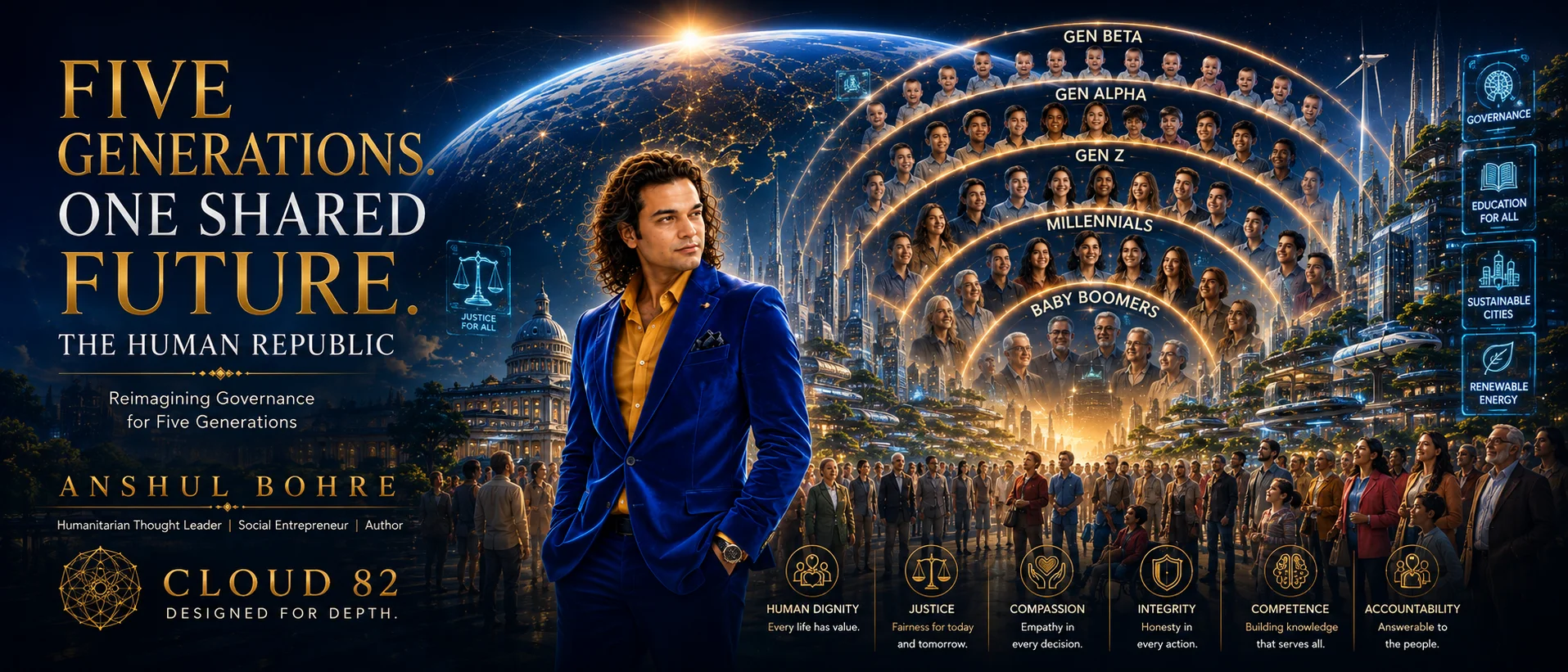
Baby Boomers, Millennials, Generation Z, Generation Alpha, and the emerging Generation Beta are not merely different age groups. They represent different technological environments, economic realities, cultural experiences, psychological landscapes, communication patterns, and expectations of authority.
One generation grew up with letters and landlines. Another grew up with television. Another with the internet. Another with smartphones, algorithms, artificial intelligence, virtual worlds, and instantaneous global communication.
Yet they share one planet.
They share the same atmosphere, the same oceans, the same cities, the same geopolitical risks, the same economic systems, and ultimately the same human future.
The fundamental question of governance, therefore, can no longer simply be:
“Who should govern?”
It must become:
“What kind of governance can understand humanity across generations—and help humanity evolve together?”
This question becomes particularly urgent when citizens lose faith in political institutions, when governments become disconnected from everyday life, when political polarization turns neighbours into enemies, when misinformation becomes more powerful than evidence, and when young people increasingly question institutions that appear designed for a world that no longer exists.
The United Nations’ World Social Report 2025 identified economic insecurity, inequality, declining social trust and social fragmentation as destabilizing forces worldwide, while reporting that more than half of the global population has little or no trust in its government. It calls for a new policy consensus based on equity, economic security and solidarity.
This is not merely a political crisis.
It is a human crisis.
And perhaps the answer requires something larger than another political ideology.
Perhaps we need a Humanitarian Governance Model—a system in which political power is treated not as personal privilege, but as a constitutional responsibility to protect human dignity, opportunity, peace and the future.
The Politician Must Become a Public Trustee
Democracy gives citizens the right to choose their representatives.
But democracy also gives representatives enormous power.
They influence laws, budgets, education, healthcare, infrastructure, taxation, national security, international relations and the future opportunities of millions of people.
If a surgeon must demonstrate competence before operating on a human body, and a pilot must demonstrate competence before flying an aircraft carrying hundreds of passengers, should society be unreasonable in expecting a person seeking enormous public authority to demonstrate minimum competence in governance?
This does not mean that a university degree automatically makes someone a good leader.
It does not.
History has repeatedly demonstrated that intelligence without character can become dangerous, while formal education without empathy can become sterile.
Therefore, the objective should not be educational elitism.
The objective should be democratic competence.
A Constitutional Public Leadership Qualification
A future democratic system could consider a compulsory Public Leadership and Constitutional Competency Examination for anyone seeking to contest elections or hold specified senior political positions.
Such an examination should not simply test academic memory.
It should evaluate:
- Constitutional literacy
- Fundamental rights and duties
- Democratic institutions
- Rule of law
- Public finance
- Economics and taxation
- Basic science and evidence literacy
- Digital and AI literacy
- Climate and environmental governance
- International relations
- Public health fundamentals
- Ethics and conflict of interest
- Human rights
- Gender equality
- Social inclusion
- Disaster management
- Media and misinformation literacy
- Federalism and decentralization
- Negotiation and conflict resolution
- Civic responsibility
- Administrative accountability
The examination should be accessible in multiple languages and designed to test understanding rather than privilege.
A farmer, teacher, entrepreneur, social worker, scientist, artist, labourer or community leader should not be excluded because they did not attend an elite university.
The principle should be simple:
Education should open the door. Competence should keep the door honest.
Existing Indian electoral systems already require candidates to disclose educational qualifications and criminal antecedents through candidate affidavits, and the Election Commission provides citizens with tools such as its Know Your Candidate platform to examine candidate information.
The next evolutionary step would be to transform transparency into demonstrable public competence.

Character Before Power
Education alone is insufficient.
A highly educated person can still be corrupt.
A highly educated person can still abuse power.
A highly educated person can still promote hatred.
Therefore, a modern leadership framework must contain a second pillar:
Character.
A serious public-office eligibility framework should include rigorous, constitutionally compliant scrutiny of:
- Criminal convictions
- Financial corruption
- Proven fraud
- Abuse of public office
- Undisclosed conflicts of interest
- False declarations
- Serious violations of electoral law
- Proven incitement to violence
- Misuse of public resources
- Deliberate constitutional violations
But there must be an equally important safeguard:
Allegation is not conviction.
A criminal accusation cannot automatically become a permanent political disqualification in a constitutional democracy.
Due process, presumption of innocence, judicial independence and the right to appeal must remain inviolable.
The objective is not to create a system where political opponents can eliminate one another through accusations.
The objective is to create a system where proven misconduct has meaningful consequences.
The Election Commission already requires disclosure mechanisms concerning criminal antecedents, assets, liabilities and educational qualifications, while political parties have disclosure obligations concerning candidates with criminal cases.
The future system should make political accountability deeper, faster and more transparent.
Political Parties Should Also Pass the Test
The reform cannot stop with individual politicians.
A democracy is shaped by its political parties.
If parties reward criminality, corruption, hatred, misinformation or opportunism, individual candidate screening will never be enough.
Therefore, political parties themselves should meet minimum constitutional and ethical standards.
A future Democratic Party Accreditation Framework could require parties to demonstrate:
- Internal democratic processes.
- Transparent financial accounts.
- Auditable political donations.
- Candidate-selection transparency.
- Internal ethics committees.
- Anti-corruption mechanisms.
- Gender and social inclusion policies.
- Constitutional commitment.
- Disclosure of conflicts of interest.
- A code against political violence and hate campaigns.
- Transparent leadership succession.
- Periodic independent compliance audits.
Political parties should not merely ask citizens to trust them.
They should earn that trust.
The Politics of Defection: When a Mandate Is Treated Like Personal Property
One of the most corrosive problems in representative politics is the political defection of elected representatives.
Imagine a citizen votes for Candidate A because Candidate A represents Party X.
After winning, Candidate A abandons Party X and joins Party Y—potentially changing the balance of power and, in some circumstances, the government itself.
The question is profound:
Whose mandate was it?
The politician’s?
Or the people’s?
India already has constitutional anti-defection provisions through the Tenth Schedule. It provides for disqualification in circumstances including voluntarily giving up membership of a political party or voting contrary to party directions in specified circumstances, subject to constitutional exceptions.
Yet the democratic conversation can go further.
A Stronger Anti-Defection Principle
A future constitutional amendment could establish a clearer doctrine:
An elected mandate shall not become a negotiable personal asset.
A representative who changes political affiliation after being elected on a party ticket should ordinarily:
Resign → Face the electorate → Seek a fresh mandate.
That principle would allow political conscience while protecting democratic legitimacy.
If an elected representative fundamentally disagrees with the party that brought them to office, they should have the moral and democratic freedom to leave.
But they should not necessarily have the automatic right to carry the electoral mandate into another party.
There should, however, be carefully defined exceptions—for example:
- Genuine party dissolution
- Constitutional mergers meeting a high democratic threshold
- Situations involving proven persecution or serious constitutional violations
- Independently verified circumstances where the original party ceases to exist in meaningful legal or organizational terms
Any such exception must be narrowly defined.
India’s existing constitutional framework already recognizes a merger exception under the Tenth Schedule, while recent Supreme Court jurisprudence has emphasized that defection proceedings must be decided within a reasonable period and discussed an outer three-month period in ordinary circumstances.
The deeper reform should be to ensure that political accountability cannot be delayed until it becomes politically irrelevant.

The Five-Generation Government
The government of the future must understand something today’s institutions often overlook:
Generational difference is not a problem to eliminate. It is intelligence to integrate.
Baby Boomers: The Generation of Institutional Memory
Baby Boomers often carry deep experiences of:
- institutional development
- industrial transformation
- geopolitical change
- traditional communities
- analogue communication
- long-term professional careers
- family and civic structures
They bring memory.
Governments need that memory.
A society without memory repeatedly makes old mistakes.
Millennials: The Generation of Transition
Millennials experienced the transition between two worlds.
They remember life before smartphones while becoming adults in the digital economy.
They have encountered:
- globalization
- economic restructuring
- social media
- entrepreneurship
- housing affordability challenges
- changing employment models
- climate anxiety
- rapid technological disruption
They understand transition because they lived it.
They can become bridges between generations.
Generation Z: The Generation of Transparency
Gen Z has grown up in an environment of:
- smartphones
- social platforms
- global information
- digital communities
- climate consciousness
- identity debates
- economic uncertainty
- AI acceleration
They expect institutions to communicate faster and more transparently.
They are less willing to accept:
“Because this is how it has always been done.”
Their political energy can become disruptive—but disruption can be productive when institutions know how to listen.
Generation Alpha: The AI-Native Generation
Generation Alpha will experience artificial intelligence not as a revolutionary invention but as part of the ordinary environment.
Their education, employment, creativity, friendships and relationship with information will be profoundly shaped by AI.
Government must therefore prepare for:
- AI-assisted education
- AI-enabled healthcare
- automation
- digital identity
- algorithmic governance
- data rights
- deepfakes
- synthetic media
- cyber risks
- new employment models
The government that ignores this generation will eventually govern a world it does not understand.
Generation Beta: The Civilization We Are Building Now
Generation Beta is emerging into a world where AI, automation, biotechnology, climate adaptation and immersive digital environments may be normal.
This generation should not inherit merely the consequences of today’s decisions.
They should inherit the wisdom behind today’s decisions.
That requires intergenerational governance.

From Generational Conflict to Generational Collaboration
A government designed for five generations should establish a permanent Intergenerational Council.
Its role would be to evaluate major policies through a generational lens.
Every major national policy could be assessed using five questions:
1. What does this mean for older citizens?
2. What does this mean for working-age adults?
3. What does this mean for today’s youth?
4. What does this mean for children?
5. What does this mean for people who have not yet been born?
This creates something humanity desperately needs:
a political voice for the future.
The Government We Need Is Not Bigger. It Is Deeper.
The answer to modern political instability is not necessarily a larger government.
It is better governance.
The UN Development Programme describes inclusive, accountable and effective governance as fundamental to sustainable development and notes that governments face simultaneous pressures from technological change, inequality, climate disruption, debt, dissatisfaction and weakened multilateralism.
A robust government of the future should therefore be:
Constitutional — power remains subordinate to law.
Competent — decisions are based on evidence and expertise.
Compassionate — citizens are treated as human beings rather than statistics.
Transparent — public decisions are explainable.
Accountable — misconduct produces consequences.
Adaptive — institutions evolve with society.
Digital — technology improves public services without destroying privacy.
Decentralized — local communities have meaningful power.
Intergenerational — policy considers both today’s citizens and tomorrow’s.
Humanitarian — dignity remains the ultimate unit of governance.
What About Anti-Government Sentiment?
Anti-government sentiment is often treated as an enemy.
That is a mistake.
Sometimes anti-government sentiment is a warning system.
When citizens protest, question institutions, criticize leaders or demand reform, the first question should not be:
“How do we silence them?”
It should be:
“What are they telling us?”
Some protests emerge from injustice.
Some emerge from economic desperation.
Some emerge from corruption.
Some emerge from discrimination.
Some emerge from misinformation.
Some emerge from political manipulation.
Some emerge from genuine constitutional grievances.
A mature government must distinguish between them.

Protest Is Not the Enemy of Democracy
Peaceful dissent is part of democracy.
Violence is not.
This distinction is fundamental.
The state must protect peaceful assembly, freedom of expression and legitimate civic participation while responding proportionately to violence, intimidation and genuine threats to public safety.
Suppressing legitimate dissent often deepens resentment.
Listening to legitimate dissent can strengthen the social contract.
UNDP has highlighted the importance of inclusive political processes, civic engagement, social cohesion, conflict prevention, countering misinformation and strengthening rule-of-law institutions.
The answer to political anger should therefore be:
Dialogue before domination.
A Humanitarian Method for Resolving Conflict
Humanitarian governance begins with a simple premise:
Every person has dignity—even when we disagree with them.
That principle changes everything.
Instead of asking:
Who is right?
We also ask:
Who is hurting?
Instead of asking:
Who should win?
We ask:
What outcome protects human dignity?
Instead of asking:
How do we defeat the opposition?
We ask:
How do we prevent society from becoming permanently divided?
This is not weakness.
It is strategic maturity.
The Six Pillars of Humanitarian Governance
1. Dignity
Every citizen must be treated as a human being before being treated as a voter, taxpayer, consumer, employee or demographic category.
2. Justice
Compassion without justice becomes sentiment.
Justice without compassion becomes cruelty.
Humanitarian governance requires both.
3. Truth
No democracy can survive indefinitely when misinformation becomes more powerful than evidence.
Independent journalism, scientific literacy, transparent public data and digital literacy become national infrastructure.
4. Dialogue
Political disagreement must have institutional pathways.
Citizens should not have to reach the streets before government begins listening.
5. Opportunity
Social harmony cannot be manufactured while large sections of society experience permanent economic insecurity.
The UN’s 2025 social report specifically links insecurity, inequality, declining trust and fragmentation and calls for equity, economic security and solidarity.
6. Compassion
The final pillar is compassion.
Not performative compassion.
Institutional compassion.
A healthcare system that does not bankrupt families is compassion.
A justice system that protects the vulnerable is compassion.
An education system that does not abandon children is compassion.
A government that listens to citizens is compassion.

The Anti-Hate Architecture
Modern governments should treat social cohesion as seriously as economic growth.
A national Social Harmony Mission could focus on:
- interfaith dialogue
- intercultural exchange
- youth civic programmes
- digital literacy
- misinformation resilience
- conflict mediation
- community volunteering
- intergenerational programmes
- mental-wellbeing infrastructure
- peace education
- constitutional literacy
- responsible political communication
Schools should teach children not merely how to compete.
They should teach them:
how to disagree without dehumanizing.
That may become one of the most important educational skills of the twenty-first century.
Artificial Intelligence Must Serve Humanity
AI will increasingly influence politics.
It can improve public administration, detect fraud, personalize education, optimize infrastructure and expand access to government services.
But AI can also amplify misinformation, political manipulation, surveillance and social polarization.
Therefore, the future requires:
Human-centered AI governance.
Algorithms used by governments should be subject to:
- transparency
- independent audits
- privacy protections
- human oversight
- explainability where appropriate
- non-discrimination standards
- appeal mechanisms
- cybersecurity requirements
Technology must become a servant of democracy—not its invisible ruler.
UNDP’s recent work on “new ways of governing” has specifically highlighted AI and data governance, evidence-informed policymaking, democratic innovation and public finance as central governance challenges.
The Constitution Must Protect the Citizen From the State—and the State From Chaos
A strong government is not one that can do anything.
A strong government is one that knows what it must never do.
Constitutionalism exists precisely because concentrated power can become dangerous.
Therefore, any constitutional amendment establishing political qualifications must itself contain safeguards against political abuse.
The framework should guarantee:
- judicial review
- independent election administration
- transparent examinations
- non-discriminatory eligibility criteria
- reasonable accommodation
- due process
- appeal rights
- privacy protection
- independent criminal verification
- transparent party accreditation
- periodic constitutional review
The objective should never be to create a political class that is difficult to challenge.
It should be to create political institutions that are difficult to corrupt.
The Global Governance Model: From Nation-States to Human Civilization
The world remains organized primarily around nations.
But many of humanity’s greatest challenges do not respect borders.
Climate change does not need a passport.
Artificial intelligence does not stop at customs.
Pandemics do not recognize political boundaries.
Ocean pollution does not respect territorial waters.
Cybercrime is global.
Financial crises are interconnected.
Disinformation crosses continents in seconds.
Therefore, national governments must remain strong while international cooperation becomes stronger.
The future requires a layered model:
Local governance → National governance → Regional cooperation → Global humanitarian coordination.
The principle should be:
Think globally. Govern locally. Protect universally.

The New Definition of Political Success
For centuries, political success has often been measured through:
- elections won
- seats controlled
- GDP growth
- infrastructure built
- military strength
- political longevity
The future should add another scorecard.
Human Development.
A government should be evaluated by:
- quality of life
- educational outcomes
- healthcare access
- social mobility
- trust in institutions
- corruption levels
- environmental resilience
- public safety
- equality of opportunity
- youth wellbeing
- older citizen dignity
- intergenerational mobility
- social cohesion
- citizen participation
A nation should not merely ask:
“How powerful are we?”
It should ask:
“How human have we become?”
A Constitutional Amendment for the Human Era
A comprehensive reform package could be built around a principle called the:

Constitutional Humanitarian Governance Amendment
Its architecture could include:
Article I — Public Leadership Competency
Mandatory constitutional and governance competency certification for specified elected offices.
Article II — Ethical Eligibility
Enhanced scrutiny of proven serious criminal misconduct, corruption and constitutional violations, subject to due process.
Article III — Democratic Party Accreditation
Political parties must meet minimum standards of internal democracy, financial transparency and constitutional compliance.
Article IV — Mandate Protection
Defection after election should ordinarily require resignation and a fresh electoral mandate.
Article V — Independent Enforcement
Election and ethics mechanisms should operate independently from the immediate political interests of the government.
Article VI — Intergenerational Governance
Major national policies should undergo long-term social, environmental and generational impact assessments.
Article VII — Citizen Participation
Permanent mechanisms for public consultation, petitions, participatory budgeting and civic deliberation.
Article VIII — Digital Democracy
Protection against algorithmic manipulation, political deepfakes, unlawful surveillance and large-scale disinformation.
Article IX — Humanitarian Governance
Public policy must respect human dignity, equality, liberty, justice and peaceful coexistence.
This would not be merely electoral reform.
It would be a redesign of the social contract.
But Let Us Not Create a Democracy of Certificates
There is one danger we must confront honestly.
If political education becomes mandatory, it must never become a mechanism for creating an elite political class.
The son of a billionaire should not automatically be considered more capable than the daughter of a farmer.
A university graduate should not automatically be considered more ethical than a community worker.
A technocrat should not automatically be considered more compassionate than a teacher.
The examination must test competence—not class.
And governance must value three forms of intelligence:
Intellectual Intelligence
Can you understand complexity?
Emotional Intelligence
Can you understand people?
Ethical Intelligence
Can you distinguish what is possible from what is right?
The best leaders require all three.
From Power Politics to Purpose Politics
The twentieth century asked:
Who controls power?
The twenty-first century must ask:
What is power for?
Power is for building.
Power is for protecting.
Power is for healing.
Power is for enabling.
Power is for creating opportunity.
Power is for preventing suffering.
Power is for protecting the rights of people who may never vote for you.
That is the difference between politics as ambition and politics as service.

The Cloud 82 Philosophy of Governance
Cloud 82 has always been rooted in a larger idea:
Designed for Depth.
That philosophy can extend beyond lifestyle, creativity, wellness and experiential living into the way we imagine civilization itself.
A deeper civilization does not merely build taller buildings.
It builds deeper relationships.
A richer civilization does not merely accumulate wealth.
It expands human possibility.
A smarter civilization does not merely create better machines.
It creates better choices.
And a truly advanced civilization does not measure progress only by technology.
It measures progress by how human beings treat one another.
From Sunlight to Starlight
Every morning, humanity receives another opportunity.
Every night, we look upward at the same stars.
Those stars do not recognize political parties.
They do not distinguish between generations.
They do not ask whether someone is rich or poor.
They simply remind us that our differences exist within something much larger.
The Earth is still one home.
Our politics may divide us into nations.
Our algorithms may divide us into cohorts.
Our histories may divide us into identities.
But our future remains shared.
The Government of Tomorrow Must Be Human
The government we need is not authoritarian.
It is not anarchic.
It is not technocratic.
It is not purely majoritarian.
It is not controlled by one generation.
It is not controlled by one ideology.
It is human-centered, constitutional, competent, compassionate and accountable.
It listens to the elder people without becoming trapped in the past.
It empowers young people without dismissing experience.
It prepares children for an AI-driven future without surrendering human values.
It protects individual freedom while preserving social responsibility.
It welcomes criticism without surrendering public order.
It fights corruption without weaponizing institutions.
It protects national interests without forgetting humanity.
And above all, it understands that political opponents are not enemies of humanity.
They are human beings with whom we disagree.
A New Social Contract
Perhaps the next great political revolution will not be left versus right.
It will not be conservative versus liberal.
It will not be young versus old.
It will not be technology versus tradition.
It will be:
Humanity versus dehumanization.
The choice before us is increasingly simple.
We can build politics around fear—or around dignity.
We can build governments around control—or around trust.
We can build societies around resentment—or around responsibility.
We can use technology to manipulate people—or to empower them.
We can teach our children to defeat one another—or to understand one another.
The choice is ours.
The Humanitarian Manifesto
Let us imagine a world where:
Education prepares citizens to participate in democracy.
Character determines whether power can be trusted.
Competence determines whether leadership can be effective.
Constitutions limit power.
Elections express genuine public consent.
Political mandates belong to citizens—not politicians.
Corruption carries consequences.
Peaceful dissent is protected.
Violence is rejected.
Truth is defended.
Science informs policy.
Technology serves people.
Children are protected.
Elders are respected.
Young people are heard.
Nature is treated as infrastructure for civilization.
Economic opportunity is treated as a foundation of social peace.
Compassion is not weakness.
Kindness is not naïveté.
Love is not merely personal.
Love can become a public ethic.
Love as a Governance Principle
This may sound radical.
Perhaps it is.
But imagine redefining love politically—not as sentiment, but as a commitment to the wellbeing of another human being.
Then:
Healthcare becomes love in institutional form.
Education becomes love in generational form.
Justice becomes love with boundaries.
Environmental protection becomes love for future generations.
Social security becomes love for vulnerability.
Democracy becomes love expressed through equal civic dignity.
Peace becomes love refusing to turn disagreement into destruction.
And gratitude becomes the recognition that civilization itself is an inheritance created by millions of people we will never meet.
This is the deeper meaning of humanitarian governance.
Social Harmony Is Not Uniformity
A harmonious society is not one in which everyone thinks alike.
That is conformity.
Harmony is different.
In music, harmony exists because different notes coexist.
Human civilization should work the same way.
Different generations.
Different cultures.
Different languages.
Different beliefs.
Different political philosophies.
Different lifestyles.
Different experiences.
Different dreams.
One humanity.
The goal is not to erase difference.
The goal is to make difference livable.
The Future We Choose
Baby Boomers will continue to carry memories.
Millennials will continue to navigate transition.
Gen Z will continue to demand transparency.
Gen Alpha will grow up alongside artificial intelligence.
Gen Beta will inherit the civilization we are constructing now.
And somewhere between them stands the government.
The government has a choice.
It can remain trapped in twentieth-century political architecture.
Or it can evolve.
It can become a multigenerational institution.
A humanitarian institution.
A learning institution.
A transparent institution.
A constitutional institution.
An institution that understands one fundamental truth:
The purpose of government is not to make people serve power. The purpose of government is to make power serve people.
That is the beginning of a new social contract.
And perhaps the beginning of a new civilization.

Conclusion: Designed for Depth
The future does not need perfect politicians.
It needs accountable ones.
It does not need governments that never make mistakes.
It needs governments capable of recognizing mistakes, correcting them and learning from them.
It does not need citizens who always agree.
It needs citizens who can disagree without destroying one another.
It does not need a world without differences.
It needs a world mature enough to live with them.
The next generation of governance must therefore be built on a deeper foundation:
Competence without elitism.
Authority without arrogance.
Justice without cruelty.
Freedom without irresponsibility.
Technology without dehumanization.
Tradition without stagnation.
Progress without exclusion.
Power without corruption.
Politics without hatred.
And above everything:
Humanity without hierarchy of human worth.
This is the governance model the future deserves.
Not merely a stronger government.
A wiser government.
Not merely a more educated political class.
A more ethical one.
Not merely a more technologically advanced civilization.
A more compassionate one.
Because the ultimate measure of civilization is not how high we can rise.
It is how deeply we can care while we rise together.
Cloud 82 — Designed for Depth.
Anshul Bohre
https://anshulbohre.com/blog

The Social Mirror — Social Media, Self-Worth & Digital Wellbeing

Astral Projection: The Science of Out-of-Body Experiences, Dreams & Consciousness

Dreams, Lucid Dreaming & Parallel Universes: Can Consciousness Travel Across Dimensions?

Humanitarian Governance: Reimagining Democracy for Five Generations

Equinox: The Art of Balance
