
ASTRAL PROJECTION, ASTRAL TRAVEL & THE ASTRAL BODY
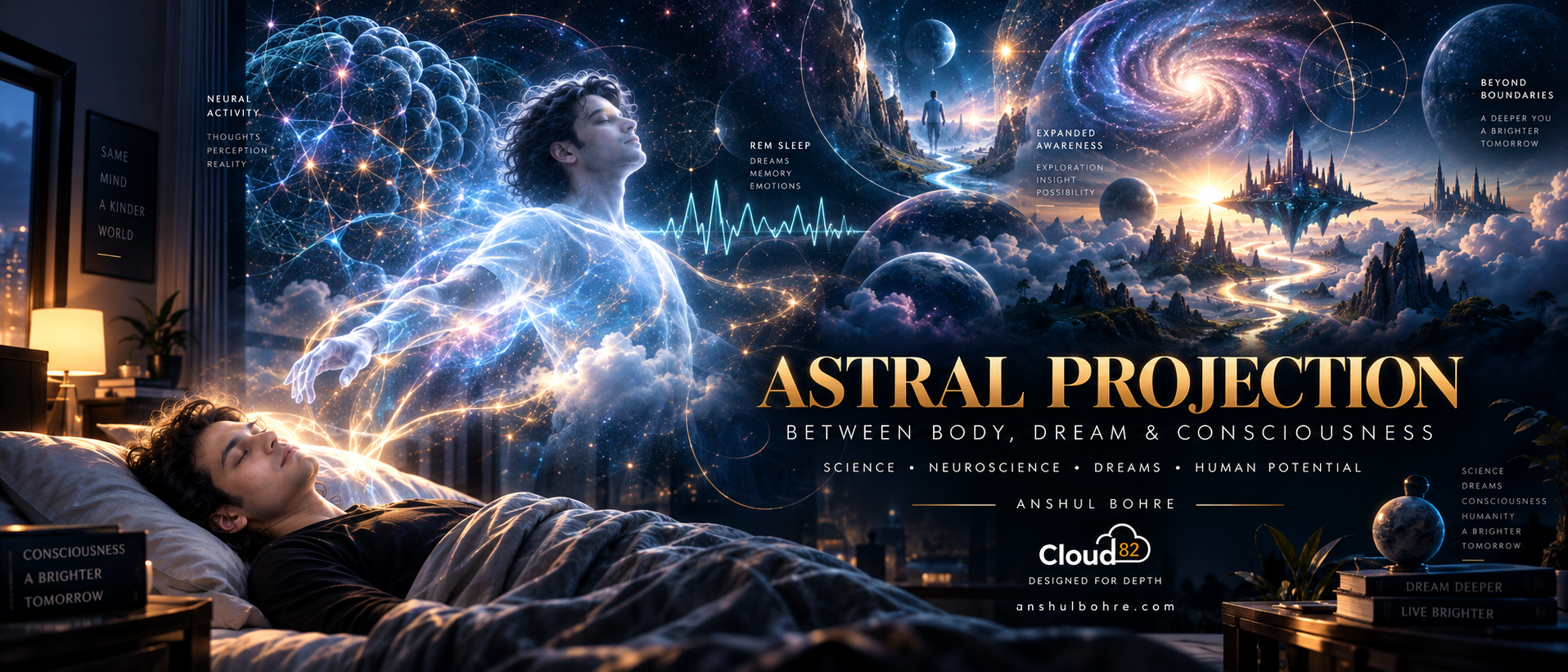
Between Consciousness, Dreams, Neuroscience and the Unknown
By Anshul Bohre | Cloud 82 — Designed for Depth
There are experiences that seem to sit at the border between dreaming and waking, between the body and the imagination, between neuroscience and spirituality.
A person falls asleep.
The body becomes deeply relaxed.
A strange vibration seems to move through the body.
There may be a sensation of floating, falling, spinning or rising.
The room may appear extraordinarily vivid.
Some people report hearing buzzing, humming or unfamiliar sounds. Others describe the feeling of separating from the physical body, looking down upon themselves, travelling through unfamiliar environments or entering an apparently different dimension of experience.
For centuries, such experiences have been interpreted through spiritual and metaphysical frameworks.
Today, they are often described using terms such as astral projection, astral travel, astral vision, soul travel, subtle-body experience or out-of-body experience (OBE).
But what actually happens?
Is consciousness capable of leaving the physical body?
Is there an “astral body”?
Are people travelling through another dimension—or is the brain constructing an extraordinarily convincing model of reality?
And perhaps the most interesting question:
What can modern science actually tell us about the experience without dismissing the experience itself?
This is where the subject becomes fascinating.
Science does not need to declare an experience meaningless simply because its traditional explanation has not been demonstrated. At the same time, a powerful subjective experience is not, by itself, proof that its metaphysical interpretation is objectively true.
The space between those two positions is where genuine exploration begins.
1. What Is Astral Projection?
Astral projection is traditionally described as an intentional experience in which consciousness—or an “astral body”—appears to separate from the physical body and travel independently.
In many spiritual traditions, the astral body is considered a subtle vehicle of consciousness. During ordinary waking life, it is thought to remain integrated with the physical body. During sleep, meditation, trance or deliberate practice, consciousness may supposedly become capable of operating independently of the physical form.
The terminology varies considerably between traditions.
Some systems speak about:
- the soul
- subtle bodies
- the etheric body
- the astral body
- the light body
- consciousness
- subtle energy
- higher dimensions
- spiritual planes
These concepts should not automatically be treated as interchangeable.
Historically, the modern expression “astral projection” became particularly prominent within Western esoteric traditions, especially Theosophy and later occult literature.
Scientifically, however, “astral projection” is not a standardized neurological diagnosis or established physical phenomenon.
Researchers generally use the term out-of-body experience (OBE) to describe the phenomenology: the subjective perception that one’s self or point of awareness is located outside one’s physical body.
That distinction is important.
An OBE describes what a person experiences.
Astral projection adds a proposed explanation of what is happening.
Science currently has considerably more evidence concerning the first than the second.
2. Astral Travel: Experience or Literal Travel?
Astral travel is usually described as a form of intentional astral projection in which the experiencer appears to move through locations, environments or dimensions.
Accounts may include:
- floating above the bed
- travelling through one’s home
- visiting distant locations
- moving through walls
- entering unfamiliar landscapes
- encountering apparently independent beings
- travelling through tunnels or luminous environments
- entering “higher dimensions”
- meeting deceased people or spiritual entities
- experiencing enormous distances in apparently little time
From a spiritual perspective, these experiences may be interpreted literally.
From a psychological or neuroscientific perspective, several other possibilities exist.
The experience could involve:
- Lucid dreaming
- REM-sleep intrusion
- Sleep paralysis
- Hypnagogic or hypnopompic hallucinations
- Dissociative experiences
- Altered multisensory integration
- Vivid mental imagery
- Memory reconstruction
- Predictive processing by the brain
- A combination of several of these mechanisms
The important scientific question therefore isn’t simply:
“Did the person experience something?”
They clearly did.
The more difficult question is:
What mechanism generated the experience, and does the experience correspond to an objectively external event?
Current evidence supports several neurological and sleep-related mechanisms for OBEs, but does not establish that consciousness literally leaves the body and travels independently through physical space.
A 2025 scoping review of 87 publications published between 1987 and 2024 found that OBEs can occur spontaneously, can be deliberately induced, and can be associated with sleep paralysis and lucid dreaming. The authors also noted that psychological, physiological and non-local-consciousness explanations have been proposed, while emphasizing the complexity and need for further research.
3. What Is Astral Vision?
“Astral vision” is not a standardized scientific term.
In spiritual literature, it generally refers to the perception of environments, entities, energies, symbols or locations during an altered state of consciousness.
People sometimes describe:
- seeing their own body from above
- seeing their bedroom while apparently outside their body
- seeing luminous beings
- seeing geometric patterns
- perceiving colors or light
- seeing places inaccessible to their physical senses
- experiencing panoramic or 360-degree awareness
- perceiving environments with unusual clarity
Neuroscience provides an important insight here.
Seeing does not necessarily require ordinary visual perception.
The brain can generate extraordinarily convincing visual experiences without incoming visual information from the external environment.
Dreams provide the most obvious example.
During a dream, a person can see:
- people
- buildings
- landscapes
- faces
- colors
- movement
- spatial environments
even though the eyes may be closed.
Therefore, the subjective vividness of astral vision does not establish that the visual information came from an external astral environment.
It demonstrates something equally fascinating:
The human brain is capable of constructing immersive worlds from internally generated information.
4. The Astral Body
The astral body is traditionally described as a subtle, non-physical body associated with consciousness, emotion, perception or spiritual identity.
Different traditions describe it differently, so there is no universally accepted definition.
A common conceptual model looks something like this:
Physical Body → Subtle/Etheric Layer → Astral Body → Higher Mental/Spiritual Consciousness
In this framework, the physical body represents biological existence while the astral body represents a subtler level of experience.
This can be a meaningful philosophical or spiritual model.
But scientifically, the situation is different.
There is currently no established anatomical or physiological evidence demonstrating the existence of an independently travelling astral body.
Neuroscience instead investigates the mechanisms underlying our ordinary sense of embodiment—the feeling that “I am located here, inside this body.”
And this is where things become surprisingly close to the language of astral experience.
5. The Brain’s Construction of “Where I Am”
We tend to assume that our sense of being located inside our body is automatic.
It isn’t.
The brain continuously integrates information from:
- vision
- touch
- proprioception
- vestibular sensation
- hearing
- motor signals
- spatial memory
- internal bodily signals
Together, these systems construct a dynamic model of:
“Where is my body?”
and
“Where am I in relation to my body?”
This is known as an important aspect of bodily self-consciousness.
The temporo-parietal junction (TPJ) has repeatedly emerged as an important region in research on bodily self-location and out-of-body experiences.
Researchers have proposed that disruption of multisensory integration at the TPJ can produce a mismatch between visual, tactile, proprioceptive and vestibular information, contributing to the feeling that the self has moved outside the body.
This is one of the strongest scientific clues surrounding OBEs.

6. The Famous Neuroscience Connection: The Temporoparietal Junction
One of the most remarkable findings in this field came from neurological research involving brain stimulation.
Researchers have reported that electrical stimulation involving regions around the right temporoparietal junction can produce experiences resembling components of an OBE.
One documented case involved repeated induction of an out-of-body experience through stimulation of the posterior right superior temporal region. PET imaging showed activity involving the temporoparietal region and related structures.
This does not mean scientists have “proved that astral projection is fake.”
It demonstrates something more precise:
Changing brain activity can alter the experience of where the self is located.
That is a profound finding.
If manipulating neural systems can cause the subjective location of consciousness to shift, then our ordinary sense of embodiment is not simply a passive reflection of physical reality.
It is an active construction.
7. The Vestibular System and the Feeling of Floating
Why do people experiencing OBEs so often report:
- floating
- flying
- spinning
- rising
- falling
- being pulled upward
- weightlessness?
One possible answer involves the vestibular system.
The vestibular system helps the brain determine:
- balance
- orientation
- acceleration
- movement
- gravitational reference
- spatial position
Research has linked vestibular processing with bodily self-location and first-person perspective.
The TPJ receives and integrates information relevant to this spatial representation of the self. Disturbances in this system can therefore produce unusual sensations of movement, elevation or disembodiment.
Experimental work has also demonstrated that visual-vestibular stimulation can produce illusions resembling aspects of out-of-body experiences.
This helps explain why an OBE can feel physically real even when no literal physical movement has occurred.
8. Astral Projection and Dreams
Perhaps the strongest bridge between astral projection and modern neuroscience is dreaming.
A dream is not merely a random movie playing in the brain.
It is a complex conscious experience involving:
- perception
- memory
- emotion
- spatial representation
- self-awareness
- narrative construction
- bodily sensations
- imagination
Astral experiences frequently occur around the boundary between sleep and waking.
This is significant.
A 2024 review in Neuroscience & Biobehavioral Reviews proposed that sleep-related OBEs may be associated with REM-sleep intrusion, dissociated REM states and sleep-onset REM periods. The authors emphasized the need for polysomnography, EEG and fMRI studies specifically examining OBEs emerging from sleep and dreaming.
In other words:
The transition between waking consciousness and REM sleep may be one of the most important laboratories for understanding OBE-like experiences.
9. Astral Projection vs. Lucid Dreaming
These experiences can overlap, but they are not necessarily identical.
Lucid dreaming
A lucid dream occurs when a person realizes:
“I am dreaming.”
The dream environment can remain vivid while metacognitive awareness increases.
Some people can influence:
- their movement
- environment
- characters
- narrative
- sensory experience
Out-of-body experience
An OBE involves the experience that:
“I am located somewhere other than inside my physical body.”
The experience may or may not occur during a dream.
Astral projection
Astral projection adds a metaphysical interpretation:
“My consciousness or astral body has separated from my physical body.”
Therefore:
Lucid dreaming = a state of conscious awareness within a dream.
OBE = an experience of altered bodily self-location.
Astral projection = an interpretation/practice in which the experience is understood as consciousness leaving the physical body.
These concepts can overlap phenomenologically, but they should not be treated as scientifically synonymous.
Recent research continues to debate exactly how OBEs and lucid dreams should be differentiated. A 2025 phenomenological analysis argued that many commonly proposed distinguishing features are unreliable and suggested that perceived disembodiment may be the most useful phenomenological criterion.
10. Sleep Paralysis: The Mysterious Gateway
Sleep paralysis is another important piece of the puzzle.
During REM sleep, the brain normally suppresses most voluntary skeletal muscle activity. This helps prevent us from physically acting out our dreams.
Sometimes elements of REM consciousness and waking consciousness overlap.
A person may become mentally aware while muscular paralysis persists.
The result can be extraordinary.
People may experience:
- inability to move
- pressure on the chest
- buzzing
- vibrations
- sounds
- voices
- visual figures
- sensations of presence
- floating
- flying
- falling
- leaving the body
A review of sleep paralysis and lucid dreaming found a significant relationship between the two, although researchers emphasized that the literature remains limited and methodologically diverse.
This is particularly relevant to reports of “astral vibrations.”

11. What Is the “Vibrational State”?
Practitioners of astral projection frequently describe a stage called the vibrational state.
Descriptions include:
- electrical buzzing
- humming
- internal vibration
- pulsing
- pressure
- waves moving through the body
- intense tingling
- energy rushing through the body
- a sensation of being electrically charged
Within spiritual frameworks, these sensations may be interpreted as energy moving through the subtle body.
From neuroscience, there are several possible explanations.
They may involve combinations of:
- altered proprioception
- vestibular sensations
- REM-related phenomena
- somatic hallucinations
- hypnagogic imagery
- muscle sensations
- auditory hallucinations
- autonomic changes
- heightened attention to internal sensations
Interestingly, recent phenomenological research notes that unusual sensations such as vibrations, buzzing and electricity are reported in both OBEs and lucid dreams and therefore cannot reliably distinguish the two.
So the vibration is real as an experience.
Its metaphysical interpretation remains unverified.
12. Deep Relaxation
Many astral-projection practices begin with deep physical relaxation.
This is not mysterious.
Relaxation reduces ordinary sensory and motor engagement and makes subtle internal sensations more noticeable.
A basic relaxation sequence might involve:
- Lie comfortably on your back or in another comfortable position.
- Allow the body to become still.
- Relax the face, jaw and shoulders.
- Slow the breathing naturally.
- Progressively relax the arms, torso and legs.
- Allow thoughts to arise without following them.
- Maintain gentle awareness while the body becomes increasingly quiet.
The objective is not to force an experience.
It is to observe the transition between waking awareness and sleep.
This is essentially a laboratory of consciousness.

13. Visualization
Visualization is another common practice.
A practitioner might imagine:
- floating above the body
- climbing an imaginary rope
- rolling sideways
- rising toward the ceiling
- moving through a doorway
- expanding into surrounding space
- travelling toward a chosen location
From a psychological perspective, visualization recruits the brain’s capacity for mental imagery and spatial simulation.
The more immersive the imagery becomes, the more convincing the experience can feel.
This does not prove that an astral body has departed.
But it demonstrates how consciousness can generate an internally experienced spatial environment.
14. The “Rope Technique”
One popular method involves imagining an invisible rope hanging above the body and mentally climbing it.
The physical body remains motionless.
The practitioner imagines:
reach → grasp → pull → rise → repeat.
The purpose is to shift attention away from ordinary bodily sensations while maintaining a thread of conscious awareness.
A scientific interpretation would view this as a form of sustained mental imagery during an altered state of arousal.
A spiritual practitioner may interpret it as an intentional separation technique.
Both descriptions refer to the same subjective practice but assign different explanations to it.
15. The Wake-Back-to-Bed Approach
Another approach involves waking after several hours of sleep, remaining awake briefly, and returning to bed with an intention to maintain awareness while falling asleep.
This resembles techniques used in lucid-dream research.
The underlying idea is:
Maintain metacognition while allowing the body to return to sleep.
This can increase awareness during the transition into dreaming.
However, deliberately fragmenting sleep should not become a routine at the expense of adequate sleep.
Sleep is not an obstacle to consciousness.
Sleep is one of the brain’s fundamental biological requirements.
16. Meditation and the Observer State
Meditation provides another route.
Rather than attempting to “leave the body,” the practitioner can simply observe:
- breathing
- bodily sensations
- thoughts
- emotions
- mental imagery
- changes in spatial awareness
- the transition toward sleep
Eventually, the boundary between:
“I am observing my body”
and
“I am the body”
can become experientially interesting.
This is where contemplative traditions and neuroscience can have a productive dialogue.
Meditation does not establish the existence of an astral body.
But it can provide a disciplined method for examining consciousness itself.

17. Astral Projection and Predictive Processing
One of the most interesting contemporary scientific perspectives is predictive processing.
The brain does not simply receive reality.
It continuously constructs predictions about reality and compares them with incoming sensory information.
Your sense of:
- body
- location
- movement
- identity
- environment
is therefore partly a model.
Normally:
Prediction + sensory information → stable experience of embodied self
But if sensory information becomes ambiguous, delayed, suppressed or inconsistent, the brain’s model can become unstable.
That instability may contribute to:
- floating
- spinning
- duplication of the body
- feeling located elsewhere
- seeing oneself from another perspective
- distorted body boundaries
The 2024 OBE review specifically discussed predictive-coding approaches as a potential framework connecting sleep-related OBEs with OBEs occurring during wakefulness.
This does not reduce the experience to “just imagination.”
It makes the phenomenon scientifically richer.
18. Why Astral Experiences Can Feel More Real Than Dreams
One of the most compelling characteristics of OBEs is their apparent realism.
People may report:
“It wasn’t like a dream.”
That subjective distinction deserves attention.
Dreams can contain bizarre transitions and impossible events.
OBEs may instead preserve a remarkably coherent representation of:
- the bedroom
- the physical body
- gravity
- spatial relationships
- visual perspective
But realism is not the same thing as external verification.
A sufficiently coherent internal model can feel completely real.
Virtual reality demonstrates the same principle on a technological scale.
The brain’s fundamental question is not:
“Is this metaphysically real?”
It is:
“What is the most coherent model of reality given the information currently available?”
19. Can Astral Travelers See Real Distant Locations?
This is one of the most important claims to examine scientifically.
Some practitioners claim that consciousness can leave the body and observe distant places.
If that were demonstrated under controlled conditions with repeatable accuracy beyond chance, it would have enormous scientific implications.
However, anecdotal accounts are not enough.
A rigorous experiment would need:
- a randomly selected target
- concealment of the target from participants
- objective scoring
- controls against sensory leakage
- preregistration
- replication
- statistical analysis
- independent investigators
To date, there is no established body of evidence demonstrating that astral projection reliably provides verifiable perception of distant physical locations beyond what can be explained by ordinary information, coincidence, inference, memory or experimental limitations.
This is one of the major distinctions between an extraordinary subjective experience and an objectively demonstrated phenomenon.
20. Is Astral Projection Pseudoscience?
This requires nuance.
Calling the entire subject “pseudoscience” can create an unnecessary category error.
There are actually several different propositions:
Proposition A
People sometimes experience a sensation of leaving their bodies.
Supported.
OBEs are documented phenomena in psychology, neurology and sleep research.
Proposition B
OBEs can involve unusual visual, vestibular and bodily sensations.
Supported.
Neurological and experimental research supports this.
Proposition C
OBEs can occur around sleep, lucid dreaming and sleep paralysis.
Supported by substantial but still developing evidence.
Proposition D
There is an independently existing astral body.
Not scientifically established.
Proposition E
Consciousness can leave the brain and objectively travel through an astral dimension.
Not scientifically established.
Proposition F
Astral projection reliably allows acquisition of information unavailable to the physical senses.
Not established by mainstream scientific evidence.
This distinction is essential.
The experience is scientifically legitimate to study.
The metaphysical explanation remains an open claim rather than an established scientific fact.

21. What Does the Latest Research Say?
Recent research is making the subject more interesting—not necessarily by confirming traditional astral travel, but by making altered states of consciousness increasingly measurable.
2024: Sleep-related OBEs
A major 2024 review proposed that sleep-related OBEs may arise around transitions into REM sleep and may overlap with phenomena involving lucid dreaming and sleep paralysis. The authors specifically called for more EEG, polysomnography and fMRI research.
2024: The neuroscience of lucid dreaming
A Neuron review highlighted advances in wearable neurotechnology, large-scale collaborations and increasingly sophisticated methods for studying lucid dreams.
This matters because lucid dreaming provides an experimentally accessible model for studying consciousness while the brain is asleep.
2025: Large scoping review of OBEs
A 2025 scoping review examined 87 publications covering OBE research from 1987–2024. It concluded that OBEs are heterogeneous phenomena that can occur spontaneously or be deliberately induced and can interact with sleep paralysis and lucid dreaming.
2025: OBE vs. lucid dreaming
A 2025 phenomenological paper argued that the distinction between OBEs and lucid dreams remains unresolved and that commonly proposed differences are not always reliable. It highlighted disembodiment as a potentially more useful defining feature of OBEs.
2025: Electrophysiology of non-ordinary sleep states
A 2025 Scientific Reports study examined electrophysiological characteristics of non-ordinary states during sleep and found that lucid-dream episodes showed distinguishable EEG characteristics while also partially overlapping with REM sleep.
The overall scientific direction is therefore fascinating:
Researchers are moving from asking whether these experiences are “real” toward measuring what happens in the brain and body when people experience them.
22. What Science Still Does Not Know
Science should not confuse an incomplete explanation with a complete explanation.
There are still major unanswered questions.
We do not yet have a complete theory of:
- subjective consciousness
- selfhood
- first-person perspective
- why dreams feel real
- how consciousness constructs spatial presence
- why some people experience recurrent OBEs
- why particular individuals experience extraordinary states spontaneously
- how dream consciousness differs from waking consciousness
- how precisely REM, vestibular processing and self-models interact
The 2025 scoping review explicitly emphasized that OBEs remain complex and require further investigation.
So the scientifically honest position is not:
“Astral projection has been completely explained.”
Nor is it:
“Science has proved that the astral body exists.”
The evidence currently supports a more interesting middle position:
The subjective phenomenon is real and scientifically investigable; the proposed metaphysical mechanism remains unverified.
23. A Practical, Science-Informed Exploration
For someone interested in exploring these experiences, the safest approach is not to begin by assuming a particular explanation.
Instead, treat the process as an experiment in consciousness.
Stage 1 — Prepare
Choose a quiet environment.
Avoid alcohol or recreational drugs.
Do not intentionally deprive yourself of sleep.
Allow sufficient time for normal sleep.
Stage 2 — Relax
Lie comfortably.
Relax the body progressively.
Allow breathing to become natural.
Do not force unusual sensations.
Stage 3 — Observe
Notice:
- heaviness
- lightness
- warmth
- tingling
- changes in body boundaries
- sounds
- imagery
- floating sensations
Observe rather than interpret.
Stage 4 — Maintain awareness
If sleepiness develops, allow the body to sleep while maintaining gentle observation.
Avoid excessive effort.
Stage 5 — Visualization
If desired, imagine:
- floating
- rolling
- climbing
- rising
- expanding
Remember that visualization is a mental technique, not evidence that an astral body has physically separated.
Stage 6 — Record
Immediately after the experience, write down:
- time
- sleep duration
- position
- sensations
- imagery
- emotions
- perceived location
- whether you knew you were dreaming
- whether you could control the environment
- whether you experienced paralysis
- whether you subsequently verified any apparently external information
This creates something far more valuable than mythology:
a personal dataset.
24. The Researcher’s Mindset
Perhaps the most powerful way to approach astral experiences is to adopt two perspectives simultaneously.
The Explorer
Ask:
What does this experience reveal about consciousness?
The Scientist
Ask:
What evidence supports each interpretation?
These are not enemies.
They are complementary.
You can experience wonder without abandoning critical thinking.
respect spiritual traditions without presenting metaphysical claims as scientific facts.
investigate consciousness without prematurely deciding what consciousness ultimately is.
25. The Deeper Question: What Is the Self?
Perhaps astral projection fascinates humanity because it challenges one of our most fundamental assumptions:
Where exactly is “I”?
Most of us instinctively believe:
I = this body.
But neuroscience demonstrates that the experience of embodiment is constructed from multiple interacting systems.
Your brain integrates:
vision + touch + proprioception + vestibular information + memory + prediction + attention
and generates an apparently unified experience:
“I am here.”
An OBE disrupts that unity.
Suddenly:
the body appears there,
while
the self appears here.
That separation is phenomenologically extraordinary.
And even if future research ultimately explains every aspect of the experience through neuroscience, the philosophical question remains:
Why does a brain generate a first-person experience at all?
That is a much larger mystery.

26. Astral Projection as a Consciousness Laboratory
Perhaps we have been asking the wrong question.
Instead of asking only:
“Can the soul leave the body?”
we might ask:
“What happens to the construction of self-location when the brain’s normal body model changes?”
Instead of:
“Is the astral plane real?”
we might ask:
“How does the brain construct an apparently external world when sensory input is dramatically altered?”
Instead of:
“Was I really outside my body?”
we might also ask:
“What does it mean that the mind can experience itself as being somewhere other than where the physical body is?”
These questions are scientifically tractable.
And they are philosophically profound.
27. Between Science and Mystery
There is a temptation on both sides.
One side says:
“It is spiritual, therefore science cannot understand it.”
The other says:
“It is neurological, therefore the experience means nothing.”
Both positions can be unnecessarily reductive.
An experience can have a neurological mechanism and still carry profound psychological, philosophical or spiritual meaning for the person experiencing it.
A sunset is produced by atmospheric optics.
That does not make it less beautiful.
A piece of music is produced through vibrations and neural processing.
That does not make it less meaningful.
Likewise, discovering the neural mechanisms behind an OBE would not invalidate the personal significance of the experience.
It would reveal another layer of the mystery.
28. Cloud 82 Perspective: Designed for Depth
At Cloud 82, the invitation is not simply to believe more.
It is to look deeper.
Consciousness is perhaps the most intimate frontier we possess.
We explore the universe through telescopes.
explore matter through microscopes.
the brain through neuroimaging.
But consciousness gives us something even stranger:
the ability to investigate the investigator.
Astral projection, lucid dreaming, meditation and altered states of consciousness all bring us toward that boundary.
Perhaps the most valuable destination is not an imaginary astral planet.
Perhaps it is a deeper understanding of the architecture of the self.
The body may remain still.
The brain may enter REM sleep.
The vestibular system may alter its representation of space.
The boundaries of bodily selfhood may temporarily dissolve.
And consciousness may report:
“I am somewhere else.”
Science asks:
How did that happen?
Spirituality asks:
What does it mean?
Philosophy asks:
Who is the “I” that experienced it?
And consciousness itself remains the frontier where all three questions meet.

29. Final Perspective
Astral projection is one of humanity’s most fascinating attempts to understand the relationship between consciousness and the body.
The experiences themselves—out-of-body sensations, floating, vibrations, vivid imagery, altered self-location and dream-like environments—are legitimate subjects of scientific investigation.
Research increasingly connects them with:
- REM sleep
- lucid dreaming
- sleep paralysis
- vestibular processing
- multisensory integration
- predictive processing
- the temporoparietal junction
- altered bodily self-consciousness
At present, however, neuroscience has not established the existence of an independently travelling astral body or demonstrated that consciousness can objectively leave the brain and travel through a separate astral dimension.
That distinction matters.
But so does another distinction:
Not scientifically proven does not mean psychologically meaningless.
The mystery of consciousness remains open.
And perhaps that is exactly where exploration becomes most beautiful.
We do not need to choose between wonder and evidence.
We can carry both.
Dream deeply.
Question deeply.
Observe deeply.
And never confuse mystery with certainty.
Cloud 82
Designed for Depth.
Dream Deeper. Live Brighter.
— Anshul Bohre

FAQ’s
What is astral projection?
Astral projection is a term traditionally used to describe the subjective experience of consciousness or an alleged subtle body separating from the physical body. In scientific literature, related experiences are generally discussed as out-of-body experiences (OBEs).
Is astral projection scientifically proven?
The experience of having an OBE is well documented and actively studied. However, science has not established that an independently existing astral body literally leaves the physical body or travels through an external astral dimension.
Is astral projection the same as lucid dreaming?
No. They can overlap, particularly around sleep transitions, but lucid dreaming involves awareness that one is dreaming, whereas an OBE is principally characterized by an altered sense of bodily location or disembodiment. The precise distinction remains an active research question.
What causes the feeling of leaving the body?
Research suggests that altered integration of visual, vestibular, proprioceptive and other bodily information may contribute. The temporoparietal junction is particularly important in theories of altered self-location.
What is the astral body?
The astral body is a concept found in various spiritual and esoteric traditions describing a subtle vehicle of consciousness. There is currently no established scientific evidence demonstrating an independently existing astral body.
What are astral vibrations?
Practitioners commonly describe vibrations, buzzing, pulsing or electrical sensations during attempted astral projection. Similar sensations have also been reported in OBEs, lucid dreams and sleep-related states. Their subjective occurrence is documented, but their interpretation as evidence of an “astral body” has not been scientifically established.
Can sleep paralysis cause astral projection experiences?
Sleep paralysis can be accompanied by out-of-body experiences, vivid visual, auditory and tactile phenomena, and altered perceptions of the body. Research has documented this association.
Can meditation cause an out-of-body experience?
Meditation and deep relaxation have been reported as contexts in which some people experience OBEs. However, this does not establish a supernatural mechanism. The 2025 scoping review identified meditation and relaxation among reported precipitating contexts.
Can people actually see distant locations while astral travelling?
There is no established scientific evidence demonstrating that astral projection reliably provides verifiable information about distant physical locations beyond ordinary sensory or informational access.
Is astral projection dangerous?
The subjective experience itself is not necessarily harmful, but deliberately disrupting sleep, becoming highly anxious about unusual perceptions, or confusing vivid dream phenomena with objective external events can be problematic. Anyone experiencing persistent hallucinations, severe sleep disruption, neurological symptoms or significant distress should discuss those symptoms with an appropriate healthcare professional.
“Science recognizes out-of-body experiences as genuine subjective phenomena, but current evidence does not establish that an independently existing astral body leaves the physical body or travels through an objectively demonstrable astral dimension.”
Selected scientific literature
- Out of Body Experiences: Scoping Review — 2025. The review examined 87 publications from 1987–2024 and identified psychological, physiological and non-local-consciousness hypotheses while emphasizing the complexity of OBEs.
- Out-of-body experiences in relation to lucid dreaming and sleep paralysis: A theoretical review and conceptual model — Neuroscience & Biobehavioral Reviews. The paper examines REM intrusion, sleep-onset REM periods, lucid dreaming, sleep paralysis and predictive coding.
- Distinguishing out-of-body experiences from lucid dreaming: a phenomenological analysis — 2025. The study argues that disembodiment may be a more useful phenomenological criterion than several previously proposed distinctions.
- Facilitating unusual bodily experiences and out-of-body experiences across wakefulness and sleep — recent high-density EEG/neurophenomenology research investigating bodily experiences across sleep and wakefulness.
- The out-of-body experience: disturbed self-processing at the temporo-parietal junction — foundational neuroscience work connecting OBEs with multisensory body processing at the TPJ.
- Spontaneous and induced out-of-body experiences during sleep paralysis — research examining the relationship among sleep paralysis, OBEs and associated sensory experiences.
- The clinical neuroscience of lucid dreaming — recent review examining lucid dreaming, its neurobiological basis, induction approaches and relationship with sleep and other altered states.
anshulbohre.com/blog

The Social Mirror — Social Media, Self-Worth & Digital Wellbeing

Astral Projection: The Science of Out-of-Body Experiences, Dreams & Consciousness

Dreams, Lucid Dreaming & Parallel Universes: Can Consciousness Travel Across Dimensions?

Humanitarian Governance: Reimagining Democracy for Five Generations

Equinox: The Art of Balance

anshulbohre.com/blog