
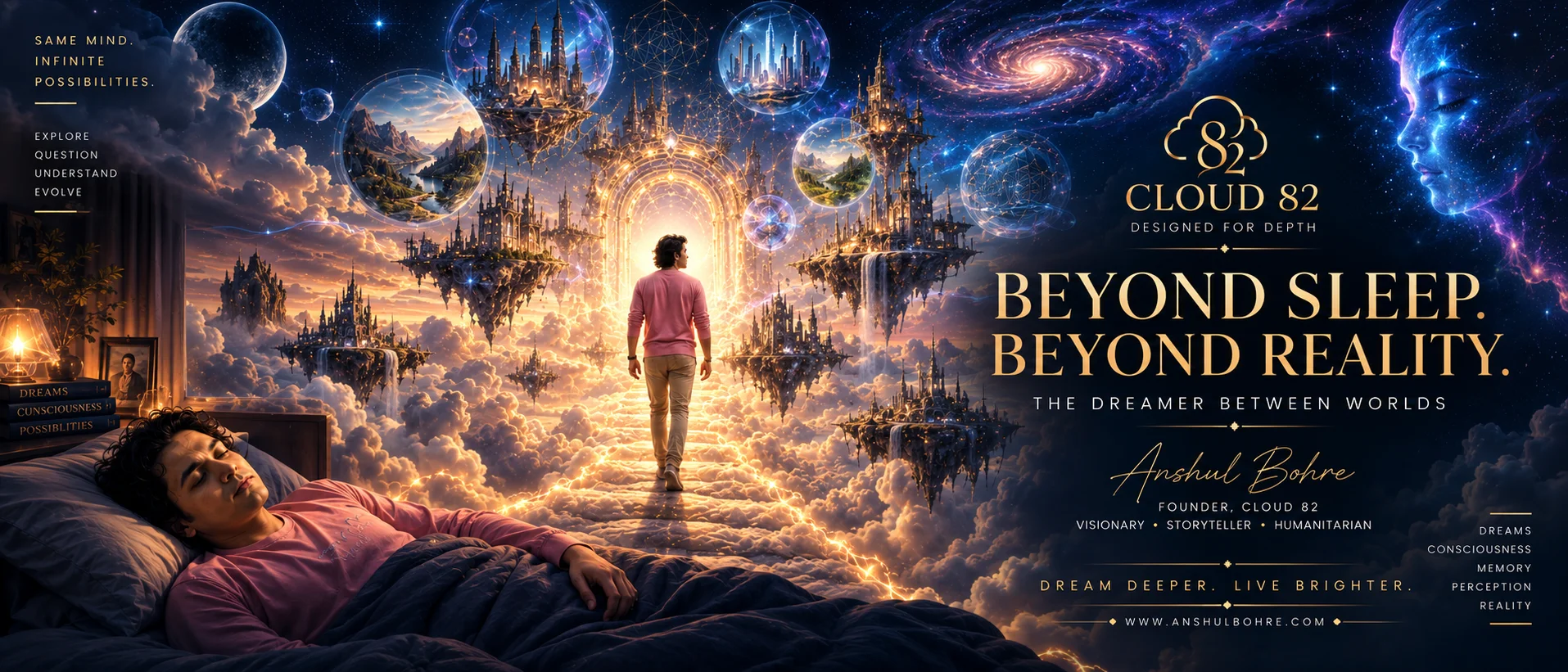
Dreams, Dimensions & the Quantum Mind: Can Lucid Dreams Take Us Beyond Reality?
“Dreams are not what we see while sleeping; rather, dreams are what keep us from sleeping.” — Anshul Bohre
There is something extraordinary about a dream.
For a few minutes—or sometimes what feels like hours—we can inhabit an entirely different world. We can meet people who are no longer alive, visit places that do not exist, become someone else, fly without wings, remember forgotten emotions, experience impossible physics, or suddenly realize:
I am dreaming.
And in that moment, the dream changes.
The sleeping brain becomes capable of something remarkable: consciousness can become aware of its own internally generated reality while the body remains asleep.
This is the phenomenon known as lucid dreaming.
But a deeper question follows.
Is a dream merely a simulation generated by the brain—or could consciousness actually be travelling somewhere?
Could a lucid dream represent access to another dimension? Another timeline? A parallel universe? Could the quantum world somehow be involved? Could the version of ourselves we encounter in a dream exist somewhere beyond ordinary spacetime?
These questions sit at the fascinating boundary between neuroscience, physics, philosophy and consciousness studies.
Science currently gives us some extraordinary answers.
But it also gives us an important warning:
An experience can be real without every interpretation of that experience being scientifically established.
That distinction is essential.
1. What Exactly Is a Dream?
For centuries, dreams were interpreted as messages from gods, glimpses of the future, journeys of the soul or windows into hidden realities.
Modern neuroscience approaches the phenomenon differently.
Dreaming is understood as a form of conscious experience occurring during sleep. It can occur during both REM and NREM sleep, although REM sleep is particularly associated with vivid, immersive dreaming.
Importantly, consciousness does not simply disappear during sleep.
Instead, its configuration changes.
Research into dreaming increasingly treats dreams as valuable experimental windows into consciousness itself. Researchers can investigate what happens when perception becomes disconnected from the external environment while internally generated experience remains extraordinarily rich.
In other words:
When you dream, your brain can construct a world without requiring the ordinary sensory evidence that normally anchors waking reality.
That is already profound.
2. Lucid Dreaming: When the Dreamer Wakes Up Inside the Dream
A lucid dream occurs when a person becomes aware, while dreaming, that they are dreaming.
Sometimes this awareness is accompanied by the ability to influence the dream.
You may suddenly think:
“This isn’t real. I’m dreaming.”
And then you may deliberately:
- fly,
- change locations,
- speak with dream characters,
- manipulate the environment,
- rehearse an activity,
- confront a fear,
- explore an imagined world,
- or simply observe the dream with heightened awareness.
Neuroscience has established lucid dreaming as a genuine sleep phenomenon rather than simply a philosophical concept. However, its neurobiology remains incompletely understood. Evidence suggests involvement of networks associated with metacognition, self-awareness and executive processing, including prefrontal and parietal regions.
The most interesting part is that lucid dreaming creates an unusual hybrid state:
the brain is asleep, yet a degree of reflective self-awareness has returned.
This makes lucid dreaming scientifically valuable because it gives researchers an opportunity to study consciousness under controlled conditions.
3. We Can Actually Communicate With Someone Who Is Dreaming
One of the most remarkable developments in modern dream science came from experiments demonstrating real-time two-way communication with lucid dreamers during REM sleep.
In a multi-laboratory study, researchers were able to communicate with participants experiencing lucid dreams and receive answers through predetermined eye movements or facial signals.
Participants could respond to questions while remaining asleep.
This demonstrated something extremely important:
A dreaming brain is not necessarily an isolated brain.
Under certain conditions, information from the external environment can enter an ongoing dream, be processed by the sleeper, and generate a deliberate response.
This fundamentally changes how we think about dreams.
The dream world is internally generated—but it is not necessarily completely sealed off from physical reality.
4. So Are Dreams Another Dimension?
Here we need to separate phenomenology from physics.
A dream can absolutely feel like another dimension.
But there is currently no established scientific evidence that lucid dreaming transports a person’s consciousness into a physically existing alternate dimension.
This distinction matters.
When you dream of an unfamiliar city, for example, your brain may generate:
- architecture,
- people,
- geography,
- weather,
- memories,
- emotions,
- conversations,
- physical laws,
- and a continuous sense of being somewhere.
The experience may be phenomenologically indistinguishable from actually being somewhere.
But phenomenological realism does not automatically imply physical realism.
In simpler language:
Feeling that you travelled somewhere does not demonstrate that you physically travelled somewhere.
Neuroscience currently provides strong mechanisms for explaining how an internally generated environment can feel spatially real.
That does not mean the philosophical question is closed.
It means the dimensional-travel hypothesis remains unproven.
5. Could Consciousness or the Soul Travel Through Dreams?
This is an even deeper question because it depends partly on what we mean by consciousness and soul.
Science can investigate measurable correlates of consciousness:
- neural activity,
- brain networks,
- electrical oscillations,
- sensory processing,
- memory,
- attention,
- metacognition,
- behavioural responses.
But science does not currently possess an experimentally established mechanism demonstrating that an independent entity called a “soul” leaves the brain during dreaming.
There are experiences that can feel remarkably like separation from the body.
These include:
- out-of-body experiences,
- sleep paralysis,
- lucid dreams,
- hypnagogic experiences,
- false awakenings,
- and vivid dream environments.
Contemporary research explores these phenomena in relation to altered sleep states, REM physiology, predictive processing and the brain’s representation of the body. A 2024 review specifically examined the relationship between sleep-related out-of-body experiences, lucid dreaming and sleep paralysis.
This gives us a scientifically interesting interpretation:
Perhaps the brain does not merely generate a picture of the world.
It also generates a model of where “I” am within the world.
Change that model—and the subjective location of the self can change with it.
That can feel like leaving the body.
Whether anything literally leaves the body is a different question, and current neuroscience has not established that.

6. What About Another Timeline?
Now we arrive at one of the most seductive possibilities.
Suppose you dream that you are living another life.
You have a different career.
You live in another city.
You are married to someone else.
You made different decisions.
You are older.
You are younger.
Or perhaps you encounter a version of yourself who chose a completely different path.
Could that person actually exist in another timeline?
From established physics, we cannot currently make that leap.
Some interpretations of quantum mechanics and some cosmological models entertain concepts involving multiple possible histories or universes. But those theories do not provide evidence that human beings can enter alternate timelines through dreams.
There is currently no experimentally demonstrated mechanism whereby:
dream → consciousness transfer → alternate timeline
occurs.
That idea belongs to speculative physics and philosophy rather than established neuroscience.
Yet there is another interpretation that is scientifically fascinating.
7. Your Brain Already Contains Thousands of Possible Versions of You
Every major decision creates a branching structure in your imagination.
What if I had taken that job?
What if I had stayed?
What if I had left?
What if I had said yes?
What if I had said no?
Your brain continuously models alternative possibilities.
Dreaming may allow some of these possibilities to become extraordinarily immersive simulations.
In that sense, a dream can become a counterfactual universe.
Not necessarily another physical universe.
But another possible version of your life.
And this may be one of the most useful ways to understand dreams scientifically.
8. Dreams as the Brain’s Generative Reality Engine
One of the most powerful ideas emerging from modern neuroscience is that the brain does not simply passively receive reality.
It continuously predicts, models and interprets incoming information.
During waking life, sensory input strongly constrains those predictions.
During dreaming, that external constraint is dramatically reduced.
The brain can therefore generate extraordinarily elaborate internal environments.
This provides a potential explanation for why dreams can contain impossible combinations:
A childhood home may exist on another planet.
A deceased relative may appear young.
You may simultaneously know and not know where you are.
Gravity may change.
Time may accelerate.
People may transform into other people.
The dream does not need to obey ordinary physical reality because the experience is being generated internally.
This does not make the experience meaningless.
Quite the opposite.
It makes the brain’s ability to generate reality astonishing.
9. Could Dreams Be Simulations of Possible Futures?
Here science becomes especially interesting.
Dreams sometimes appear to contain situations that later resemble real events.
People therefore ask:
Are dreams predicting the future?
There is currently no robust scientific evidence demonstrating that dreams provide reliable access to future events or alternate timelines.
There are several reasons why dreams can nevertheless appear prophetic.
The brain is constantly processing:
- probabilities,
- memories,
- patterns,
- emotional signals,
- subtle environmental information,
- expectations,
- fears,
- and possible future scenarios.
Dreams can therefore function as a kind of unconscious simulation space.
You may dream about something because your brain has already detected a possibility that your conscious mind has not explicitly articulated.
Later, if something similar happens, the correspondence can feel extraordinary.
But this does not necessarily mean the dream travelled into the future.
It may mean the brain was exceptionally good at prediction.
10. The Quantum Question
And now we enter the territory where scientific curiosity can easily become scientific mythology.
Quantum mechanics tells us that nature behaves in ways that are profoundly counterintuitive.
At microscopic scales we encounter:
- superposition,
- entanglement,
- probabilistic measurement,
- wave-particle duality,
- quantum fields,
- and other phenomena that challenge classical intuition.
This naturally inspires the question:
Could consciousness—and therefore dreaming—be quantum?
There are serious scientific theories proposing relationships between quantum processes and consciousness.
But this is very different from saying that dreams are portals into parallel universes.
Recent critical reviews of quantum-consciousness theories emphasize a major problem: proposed quantum mechanisms must demonstrate physical feasibility, specify a mechanism connecting those processes to subjective experience, and produce experimentally testable predictions that outperform classical explanations. Current evidence does not establish such a mechanism.
This is perhaps the most important sentence in the entire discussion:
Quantum mechanics is real. Quantum consciousness remains an open hypothesis. Quantum dreaming as interdimensional travel has not been scientifically demonstrated.
Using words such as quantum, entanglement or superposition does not by itself transform a consciousness hypothesis into physics.

11. Could Every Dream Exist Somewhere in the Quantum World?
This is a beautiful philosophical proposition.
Imagine that every possible experience corresponds to some possible state of reality.
Then perhaps the dream of you becoming an astronaut, musician, entrepreneur, explorer or completely different person corresponds to one branch of possibility.
But physics does not currently establish that subjective dream experiences correspond to independently existing universes.
The mathematical existence of a possibility is not the same as the physical existence of that possibility.
And the existence of a physical possibility is not the same as the ability of consciousness to access it.
These three concepts must remain separate:
Possible ≠ physically realized ≠ consciously accessible.
That distinction prevents fascinating speculation from becoming pseudoscience.
12. Can We Change Something in Another Dimension Through Lucid Dreaming?
There are two very different interpretations.
Interpretation 1: Change an external universe
There is currently no scientific evidence that actions performed inside lucid dreams alter an external parallel universe or timeline.
Interpretation 2: Change the internal universe
This is absolutely possible.
And this is where lucid dreaming becomes scientifically and psychologically powerful.
Within a lucid dream, people can deliberately manipulate their own experience.
They can practise actions, explore emotional situations, confront fears and experiment with alternative responses.
The dream therefore becomes a kind of virtual laboratory for the mind.
13. The Dream as a Laboratory for Human Potential
Imagine a world in which there are no physical consequences for experimentation.
You can walk onto a stage and speak before 100,000 people.
You can rehearse a difficult conversation.
You can confront a fear.
You can explore an unfamiliar environment.
You can practise movements.
You can investigate your own emotional responses.
Lucid dreaming potentially offers a remarkably immersive form of mental simulation.
Research also suggests that lucid dreaming is associated with metacognitive abilities related to distinguishing internally generated experiences from externally generated ones.
That makes lucid dreaming interesting not merely as entertainment, but as a possible tool for understanding:
How does the mind know what is real?
14. Can Dreams Change Real Life?
Yes—but the mechanism does not need to involve another universe.
Dreams can influence waking life through:
Memory
Sleep is deeply involved in memory processing, and research has found relationships between dream content and memory consolidation. A meta-analysis of experimental studies found a significant association between dreaming about learned material and subsequent memory performance.
Emotion
Dreams can provide internally generated scenarios in which emotional material is revisited and recombined.
Creativity
Dreaming can loosen ordinary associative constraints and produce unusual combinations of ideas.
Problem solving
A dream may present a problem from a novel perspective, although strong claims about dreams reliably solving complex problems should be treated cautiously.
Behavioural rehearsal
Imagining a future action can influence waking behaviour. Lucid dreaming may offer an especially immersive version of such rehearsal.
Self-reflection
A dream can reveal patterns in our fears, desires, memories and expectations—not necessarily because the dream contains supernatural messages, but because it exposes how the brain is constructing experience.
15. Dream Engineering: We Are Beginning to Manipulate Dreams
This is where cutting-edge research becomes genuinely exciting.
Scientists are increasingly experimenting with dream engineering.
Researchers can use:
- sensory stimulation,
- targeted memory reactivation,
- sleep-stage monitoring,
- lucid-dream techniques,
- computational analysis,
- neuroimaging,
- wearable technologies,
- and real-time communication.
A 2024 systematic review examined sensory stimulation during dreams and found that external stimulation can sometimes influence dream content, although results vary considerably and the mechanisms remain incompletely understood.
Another recent review describes the emerging field through three major capabilities:
observe dreams, engineer dreams and computationally analyse dreams.
That is a major conceptual shift.
For most of human history, dreams were something we could only experience.
Now researchers are beginning to ask:
Can dreams be measured?
Then:
Can they be communicated with?
Then:
Can they be influenced?
And perhaps eventually:
Can they be systematically engineered?

16. What If Future Technology Allows Direct Dream Interaction?
This is speculative—but technologically interesting.
Imagine a future sleep laboratory equipped with advanced EEG, neuroimaging, AI-based neural decoding and adaptive stimulation.
A person enters REM sleep.
The system detects lucid dreaming.
An AI reconstructs aspects of the dreamer’s neural activity.
The system introduces a controlled stimulus.
The dreamer responds.
The AI adjusts the stimulus.
The dream changes.
This would create something unprecedented:
an interactive interface between external technology and an internally generated conscious world.
Current research is nowhere near perfect dream decoding.
But the direction of research is clear: neural decoding, real-time reporting, wearable neurotechnology and computational dream analysis are increasingly becoming part of serious dream science.
17. Could AI Become a Bridge Between Dreams and Reality?
This may ultimately be more scientifically plausible than literal interdimensional travel.
AI can already analyse enormous quantities of biological and behavioural data.
Future systems could potentially learn relationships between:
- neural activity,
- sleep stages,
- physiological signals,
- language,
- imagery,
- emotional states,
- memory,
- and reported dreams.
The objective would not necessarily be to “read dreams” like subtitles.
Instead, AI might estimate:
what kinds of experiences the brain is constructing.
This could lead to a new form of human-computer interaction:
Brain → Dream → AI → Reality
And eventually perhaps:
Intention → Neural Interface → Dream Environment
That would not be a portal to another universe.
It might be something equally extraordinary:
a programmable interface to the human imagination.
18. What About Out-of-Body Experiences?
Out-of-body experiences deserve particular attention because they can feel like literal consciousness leaving the body.
A person may experience:
- floating above the bed,
- looking down at themselves,
- moving through a room,
- travelling through space,
- or existing as a disembodied point of awareness.
These experiences are subjectively powerful.
But subjective intensity is not proof of an external mechanism.
Current models investigate how alterations in body representation, multisensory integration, REM-state phenomena and predictive processing can generate experiences of being located somewhere other than one’s physical body.
The scientific question is therefore not:
“Was the experience real?”
It was certainly real as an experience.
The scientific question is:
What caused the experience?
That distinction is fundamental to consciousness research.
19. The Most Important Scientific Boundary
We can place the possibilities into four categories.
| Question | Scientific status |
| Can people dream while asleep? | Established |
| Can people become consciously aware inside dreams? | Established |
| Can lucid dreamers sometimes communicate with researchers while dreaming? | Demonstrated experimentally |
| Can dreams influence memory and cognition? | Supported, though mechanisms remain under study |
| Can dreams be experimentally influenced? | Supported, but effects vary |
| Can consciousness leave the body during dreams? | Not established |
| Can dreams access another timeline? | No scientific evidence |
| Can dreams access parallel universes? | No scientific evidence |
| Are dreams quantum portals? | No evidence |
| Is consciousness fundamentally quantum? | Open hypothesis, currently unproven |
| Can lucid dreaming transform waking cognition and behaviour? | Plausible and supported in several areas, but still under active research |
This is where wonder and scientific discipline can coexist.
20. Perhaps the “Other Dimension” Is Inside Us
There is another possibility worth considering.
Maybe the most extraordinary dimension accessible through dreaming is not somewhere else.
Maybe it is the architecture of our own mind.
Every human being carries an enormous internal universe:
memories we cannot consciously access,
faces we have forgotten,
emotions we never expressed,
future scenarios we have imagined,
possibilities we abandoned,
fears we never confronted,
and versions of ourselves that exist only as potential.
Dreaming allows fragments of this internal universe to become experiential.
It turns information into worlds.
It turns memory into narrative.
It turns possibility into experience.
And sometimes it turns the observer into an explorer.

21. The Dreamer and the Universe
There is a profound philosophical symmetry here.
The universe outside us is vast.
But so is the universe within us.
Modern cosmology asks:
How many universes could exist?
Neuroscience asks:
How many possible realities can one brain construct?
Quantum physics asks:
What is reality at its most fundamental level?
Consciousness research asks:
Why does any of it appear as experience at all?
Dream research sits at the intersection of these questions.
Because a dream creates something astonishing:
a universe without a physical journey.
A place without physical distance.
A body without ordinary movement.
A narrative without an external author.
A reality generated from within.
And perhaps that is why dreams have fascinated humanity for thousands of years.
22. What Lucid Dreaming May Eventually Teach Us
The long-term importance of lucid dreaming may have surprisingly little to do with proving parallel universes.
Its greater contribution may be helping us understand consciousness itself.
If researchers can determine:
- how self-awareness emerges during dreams,
- how perception is constructed without external sensory input,
- how memory influences dream architecture,
- how dreams can be experimentally modified,
- how dreamers communicate while asleep,
- how the brain distinguishes internal from external reality,
- and how conscious control can re-emerge during sleep,
then dreaming could become one of neuroscience’s most powerful natural laboratories.
A 2024 Neuron perspective describes precisely this emerging opportunity, highlighting wearable neurotechnology, large-scale research collaborations, citizen neuroscience and AI-assisted approaches as important developments for the field.
23. The Cloud 82 Perspective: Dream Deeper, But Question Deeper
At Cloud 82, the invitation is not to choose between science and wonder.
It is to hold both.
Dream boldly.
Question rigorously.
Explore without abandoning evidence.
Perhaps someday physics will reveal dimensions of reality that today’s science cannot yet access.
Perhaps consciousness will turn out to have properties that our current neurological models cannot explain.
Perhaps quantum theory will eventually contribute something fundamental to the science of mind.
Or perhaps the ultimate mystery will be explained entirely through neuroscience.
We do not yet know.
And that uncertainty is not a weakness.
It is where genuine science begins.
24. So, Can We Travel Through Dreams?
The scientifically responsible answer is:
We can travel through dreams experientially—but science has not demonstrated that we travel through them physically into another dimension or timeline.
Lucid dreaming gives us something astonishingly close to controlled exploration of an internally generated reality.
We can become aware.
We can sometimes interact.
We can sometimes influence.
We can remember.
We can learn.
We can rehearse.
We can transform the way we understand ourselves.
But there is currently no reliable evidence that a dreamer’s consciousness literally exits the brain and enters a parallel universe, alternate timeline or quantum dimension.
That remains a fascinating hypothesis—not an established scientific fact.
And perhaps that is exactly where the greatest question remains.

25. The Final Question
Perhaps the real mystery is not:
“Where do we go when we dream?”
Perhaps it is:
“How does the universe inside the brain become a place we can actually experience?”
Think about the impossibility of it.
Your body is lying still.
Your eyes are closed.
The room around you may be completely dark.
And yet somewhere inside your nervous system:
there is light.
There is architecture.
There are faces.
There are voices.
There is movement.
There is time.
There is emotion.
There is a sense of you.
And sometimes, incredibly, there is an awareness that says:
I am here.
I am dreaming.
That moment may not be a doorway to another physical universe.
But it is certainly a doorway into one of the greatest scientific mysteries we possess:
consciousness itself.
And perhaps the future of human exploration will not be defined only by how far we can travel outside ourselves.
Perhaps it will also be defined by how deeply we can travel within.
Dream Deeper.
Question Deeper.
Live Brighter.
Cloud 82 | Designed for Depth

Scientific Takeaway
The current evidence supports the following picture:
Dreaming is a genuine conscious phenomenon during sleep.
Lucid dreaming is a scientifically validated state in which awareness of dreaming can coexist with sleep.
Lucid dreamers can, under controlled conditions, communicate with researchers during REM sleep.
Dream content can interact with memory, emotion and cognition.
External stimulation and targeted techniques can sometimes influence dream content.
AI, neural decoding and wearable technologies are opening new ways to study and potentially engineer dreams.
But:
There is currently no scientific evidence that dreams transport consciousness into another physical dimension, parallel universe or alternate timeline.
There is no established evidence that a soul literally leaves the body during dreaming.
There is no established evidence that dreams are quantum portals or that actions in dreams modify an external parallel universe.
The frontier is therefore not closed.
It is simply unfinished.
And that may be the most exciting part.
visit : https://anshulbohre.com/

https://anshulbohre.com/blog

The Social Mirror — Social Media, Self-Worth & Digital Wellbeing

Astral Projection: The Science of Out-of-Body Experiences, Dreams & Consciousness

Dreams, Lucid Dreaming & Parallel Universes: Can Consciousness Travel Across Dimensions?

Humanitarian Governance: Reimagining Democracy for Five Generations

Equinox: The Art of Balance

anshulbohre.com/blog