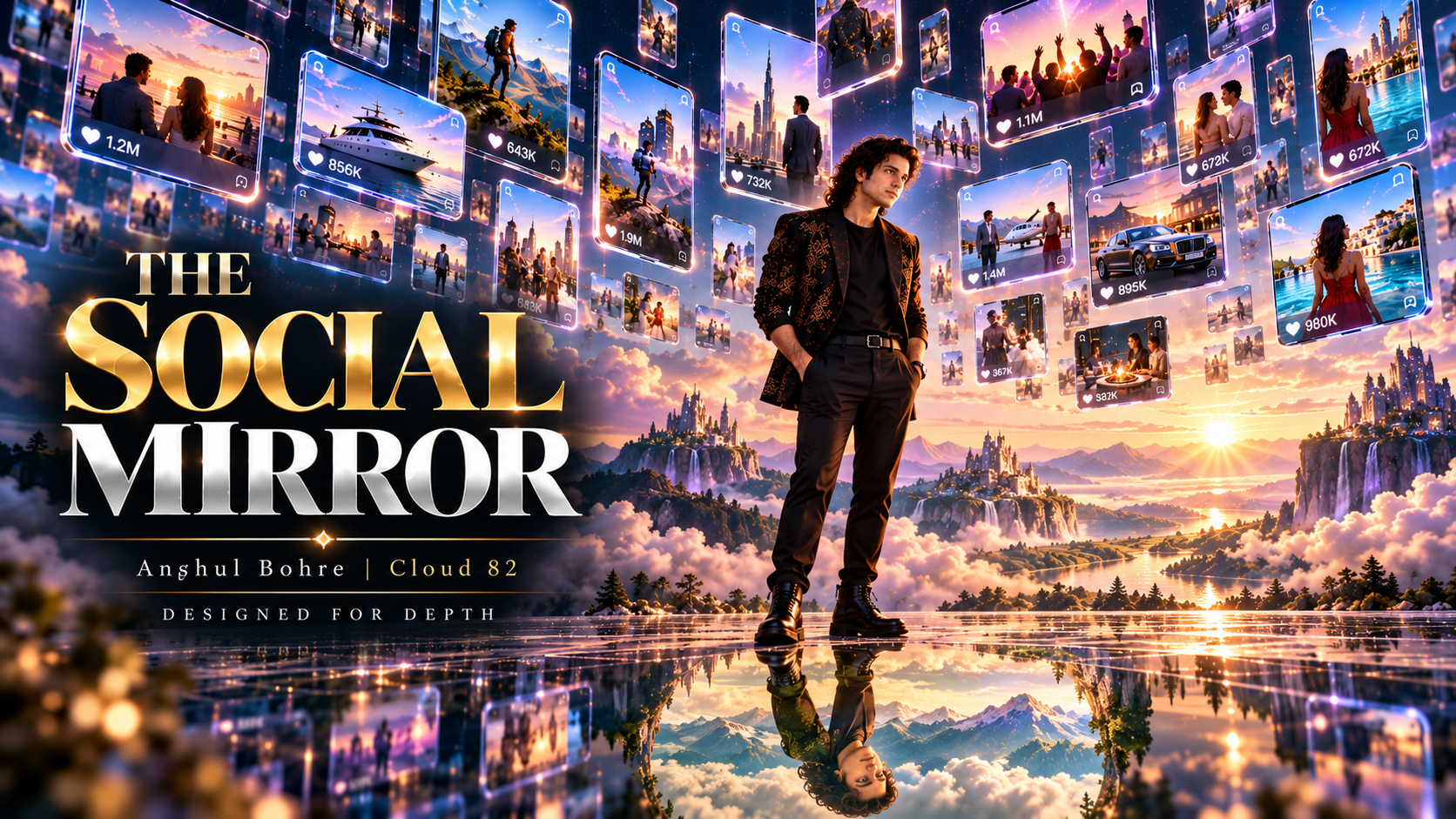
THE SOCIAL MIRROR
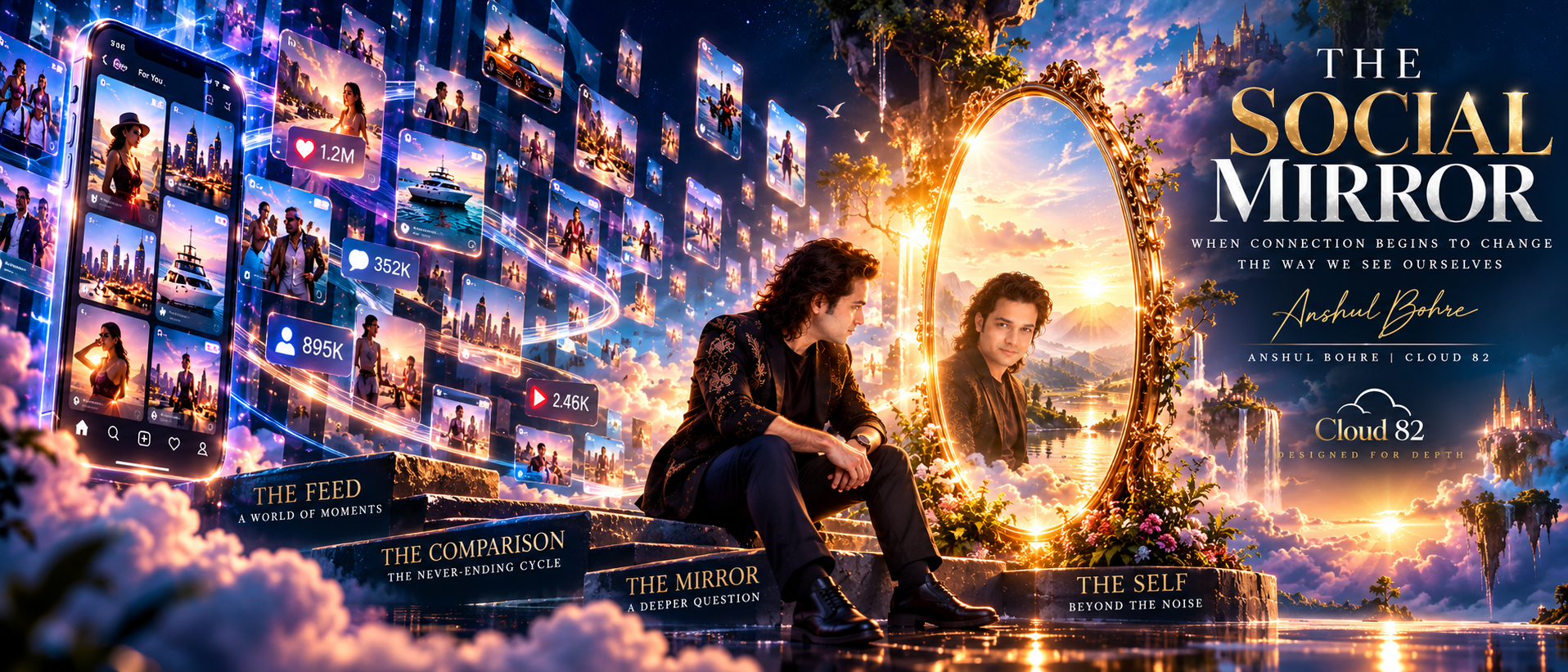
When Connection Begins to Change the Way We See Ourselves
By Anshul Bohre
Cloud 82 | Designed for Depth
There was a time when we entered the digital world deliberately.
We opened a computer.
sent an email.
searched for something.
spoke to someone.
Then the digital world learned how to come to us.
It began arriving in our pockets, on our wrists, beside our beds and, eventually, inside the quietest moments of our lives.
A notification.
A message.
A reel.
A photograph.
A headline.
A stranger’s success.
Someone else’s holiday.
else’s body, relationship., home. Someone else’s seemingly perfect life.
And without realizing it, we began carrying the lives of thousands of people inside our own minds.
Social media promised connection.
And it delivered something much larger:
a permanent social mirror.
The question is no longer whether social media connects us.
It does.
The more important question is:
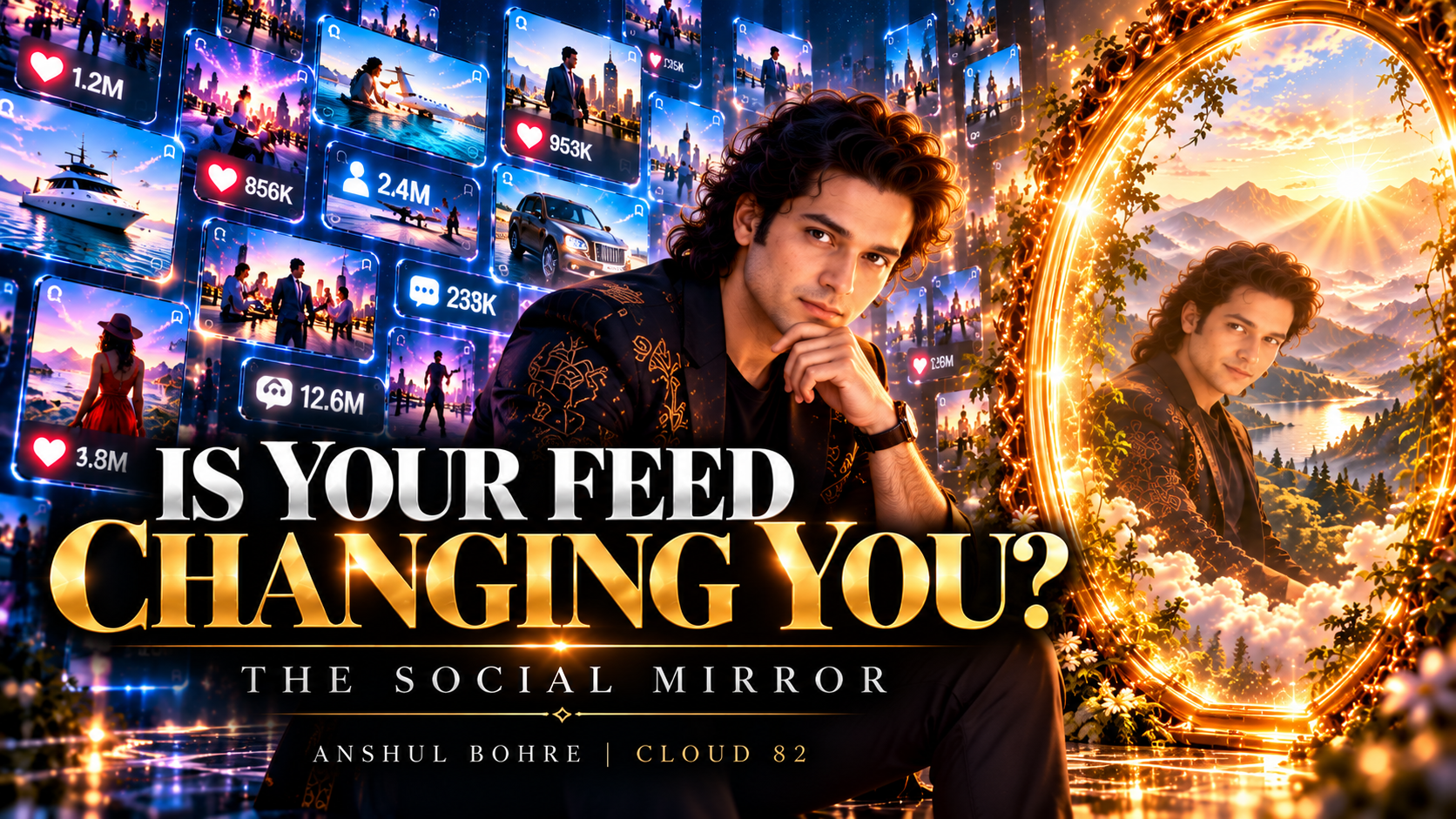
What does continuous connection do to the way we see ourselves?
THE MIRROR THAT NEVER SLEEPS
A traditional mirror reflects what is in front of it.
The social mirror is different.
It reflects what the algorithm decides deserves your attention.
That distinction changes everything.
Your social feed isn’t a neutral representation of reality.
It is a selection.
A stream of moments chosen, ranked, optimized and presented according to systems designed to keep you engaged.
The result is an unusual psychological environment.
You don’t simply observe other people’s lives.
You observe edited versions of other people’s lives while experiencing the unedited version of your own.
That is an inherently unequal comparison.
You know your doubts, unfinished work, the arguments you had, the mornings when you didn’t feel motivated, the uncertainty behind your decisions.
But when you look at someone else’s profile, you may see only the celebration.
The achievement.
The perfect photograph.
The extraordinary journey.
The beautiful relationship.
The carefully constructed sentence about success.
And then the mind quietly performs its oldest trick:
comparison.

WE WERE NEVER DESIGNED TO COMPARE WITH EVERYONE
Human beings naturally compare.
Comparison can be useful.
It can teach us, motivate us, help us understand where we stand within a community.
But digital platforms have radically expanded the scale of comparison.
For most of human history, comparison happened within relatively small social circles.
Today, a person can wake up and encounter hundreds of carefully presented lives before breakfast.
And those lives may represent the world’s most attractive, successful, wealthy, talented, adventurous or influential people.
The psychological environment has changed faster than our evolutionary instincts.
We are asking an ancient brain to interpret an unprecedented volume of social information.
Recent research has increasingly focused on upward social comparison—comparing ourselves with people whom we perceive as doing better than we are. A 2025 study involving young adults found that exposure to upward comparisons was associated with lower self-esteem and helped explain links between social-media use and depressive symptoms.
The danger isn’t seeing someone else’s success.
The danger is unconsciously translating their success into evidence of our inadequacy.
THE INVISIBLE QUESTION
Every scroll can contain an invisible question:
“Am I doing enough?”
Am I successful enough?
Attractive enough?
Rich enough?
Interesting enough?
Fit enough?
Loved enough?
Young enough?
Relevant enough?
Happy enough?
And perhaps the most dangerous question:
“Why isn’t my life like theirs?”
We rarely ask these questions consciously.
They enter quietly.
A photograph becomes a comparison.
A comparison becomes an evaluation.
An evaluation becomes a feeling.
And repeated feelings can become a belief about ourselves.
This is how a screen can influence identity without ever explicitly telling us what to believe.
THE CURATED LIFE
There is another psychological illusion we should learn to recognize.
People don’t usually post their entire lives.
They post moments.
Businesses understand this.
Brands understand this.
Creators understand this.
And increasingly, ordinary people understand it too.
We photograph the meal before eating it.
We select the best photograph, edit the lighting, remove imperfections, rewrite the caption, choose the moment, We publish.
Nothing is inherently wrong with that.
Self-expression is beautiful.
The problem begins when we forget that we are looking at curated reality.
Someone else’s highlight reel becomes the measuring stick for our behind-the-scenes.
And that is an impossible competition.
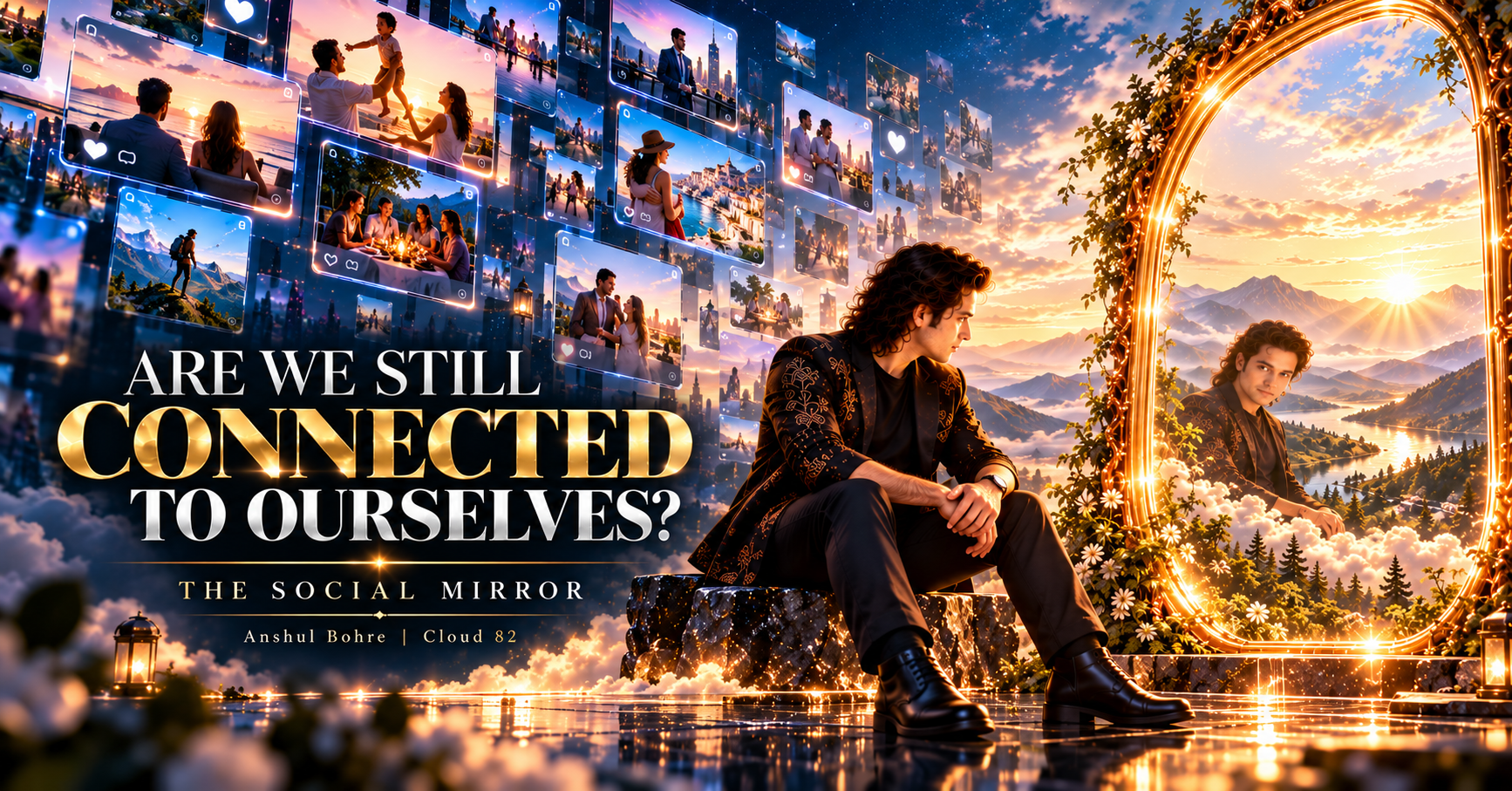
WHEN ATTENTION BECOMES THE CURRENCY
There is another transformation taking place beneath the surface.
We have gradually moved from asking:
“What do I want to experience?”
to:
“What will people think about what I experience?”
A sunset can become content.
A meal can become content.
A journey can become content.
A relationship can become content.
A birthday can become content.
Even silence can become content.
The camera sometimes arrives before consciousness.
Instead of experiencing the moment, we begin documenting the moment.
Instead of asking whether something feels meaningful, we may unconsciously ask whether it will be shareable.
And something profound happens:
the audience enters the experience before the experience is complete.
We stop living entirely from the inside out.
We begin living partially from the outside in.
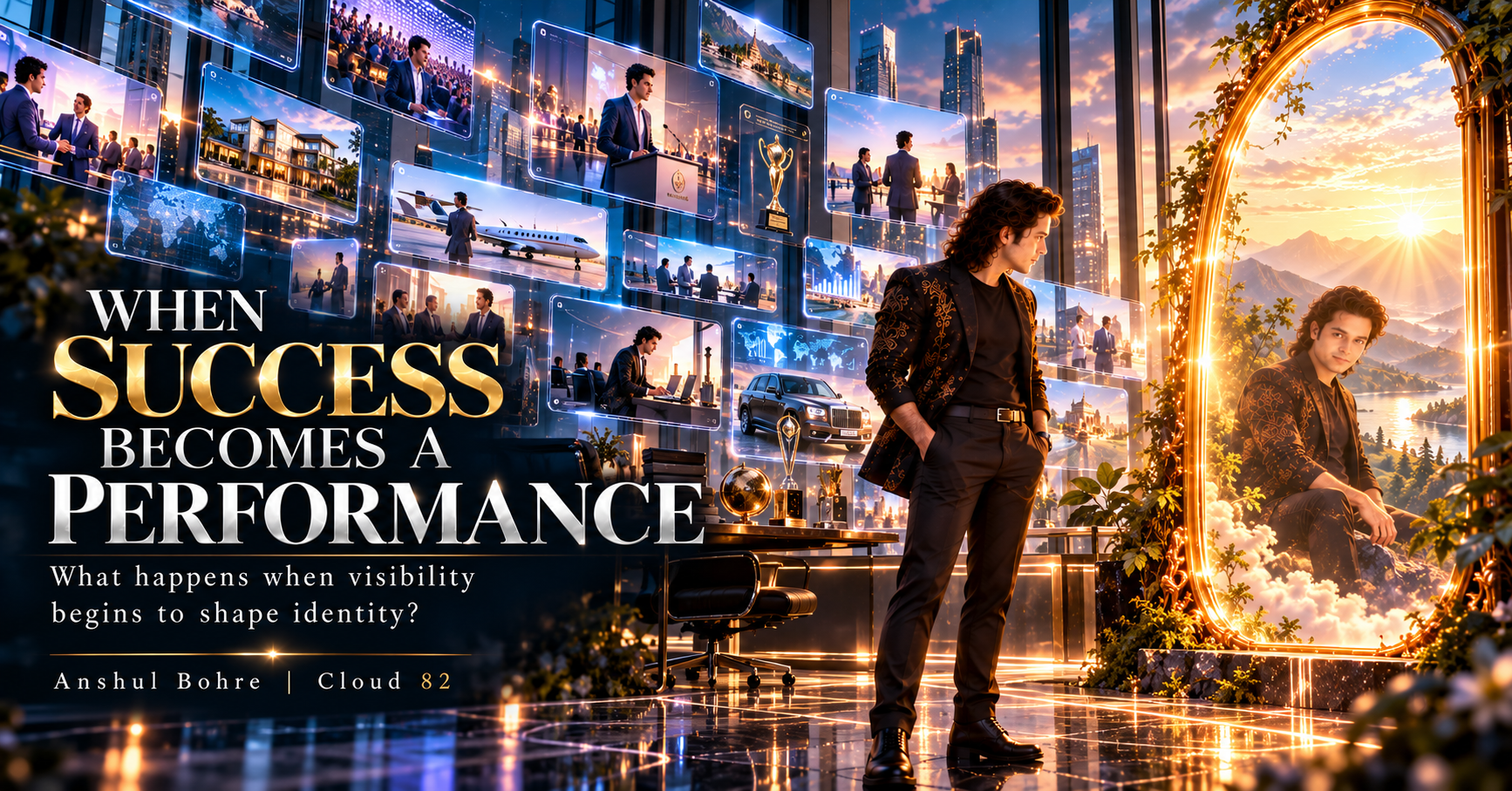
THE PERFORMANCE OF SELF
Social media has given humanity an extraordinary creative tool:
the ability to construct identity publicly.
This can be liberating.
A person can find their voice.
An artist can find an audience.
A social entrepreneur can build a movement.
A lonely person can find community.
A small business can reach the world.
A powerful idea can travel across continents in seconds.
The same technology that can create comparison can create belonging.
That is why simplistic arguments against social media miss the point.
The technology is not the villain.
The relationship we develop with the technology matters.
A platform can be a tool.
Or it can become an emotional environment.
It can amplify your purpose.
Or it can consume your attention.
It can help you express yourself.
Or slowly convince you that your worth depends on how others respond to that expression.
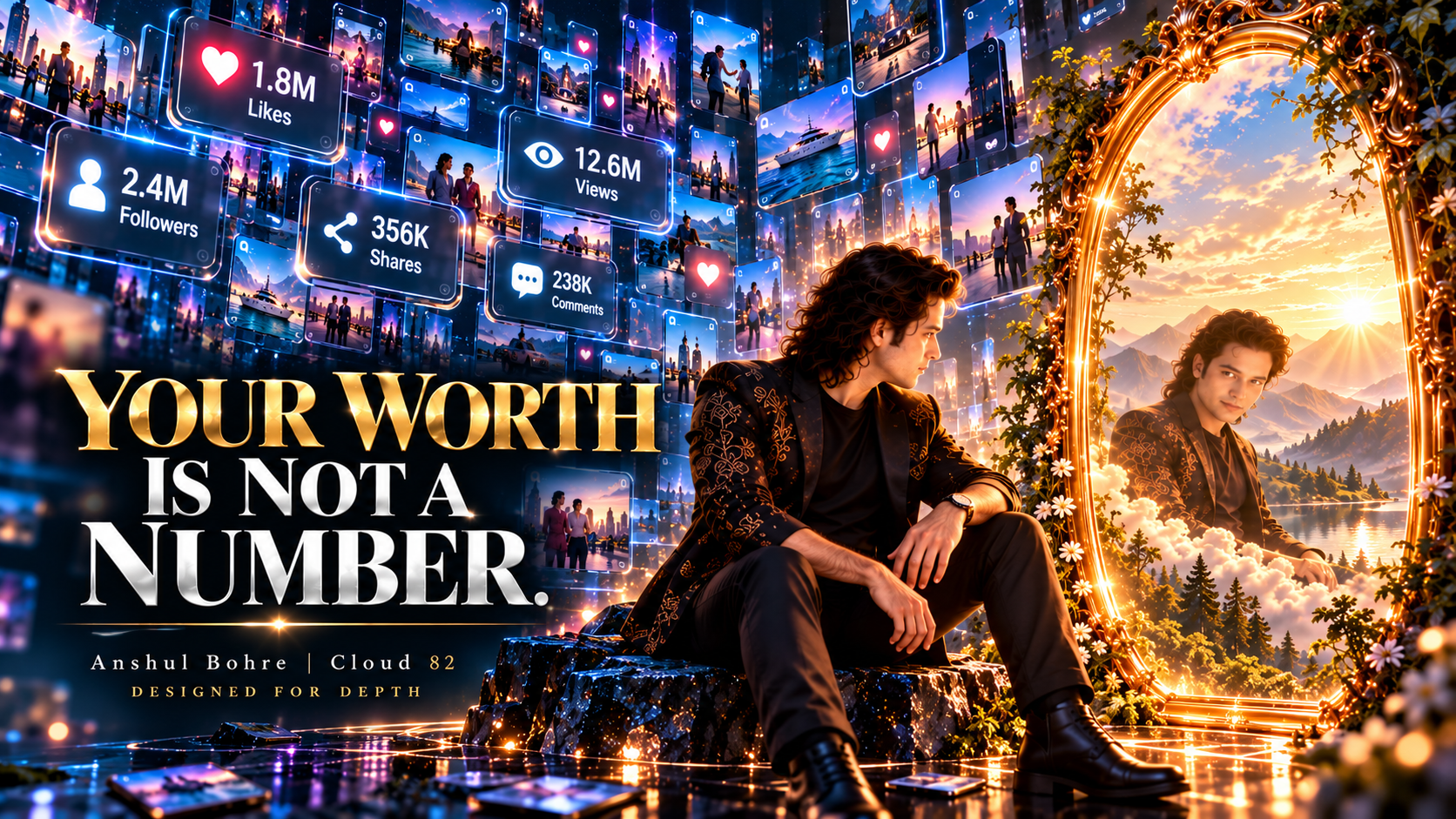
THE LIKE IS NOT A MEASUREMENT OF YOUR WORTH
One of the strangest psychological developments of the digital age is the transformation of social feedback into visible numbers.
Likes.
Views.
Shares.
Followers.
Comments.
Subscribers.
Reach.
Engagement.
These metrics are useful for communication and business.
But they become dangerous when they become psychological measurements.
A post receives fewer likes.
Something feels wrong.
A post performs exceptionally well.
We feel temporarily validated.
The number rises.
The mood rises.
The number falls.
The mood falls.
Eventually, an external metric begins participating in our internal emotional regulation.
And we may not even notice it happening.
Your audience can become an invisible board of directors for your self-esteem.
That is a dangerous board to give control to.
THE FOMO MACHINE
There is another emotion quietly powering the social internet:
Fear of Missing Out.
FOMO isn’t simply about missing an event.
It can become the fear of missing an entire version of life.
Someone is travelling, is launching, is getting married, is becoming wealthy, is building a company, is becoming famous, is discovering themselves, Someone appears to be living more intensely than you.
And suddenly your ordinary Tuesday feels like evidence that you are falling behind.
Research published in 2025 found that social comparison was the strongest predictor of FoMO in a study of university students, with loneliness, perfectionism and problematic social-media use also contributing.
But perhaps we should ask a different question.
Behind whom are we actually falling?
And who decided that life was a race?
THE COST OF CONSTANT INPUT
The human mind needs periods without social evaluation.
It needs boredom.
Silence.
Solitude.
Reflection.
Unstructured thought.
Nature.
Conversation.
Sleep.
Daydreaming.
Presence.
Yet the modern person can move from one stream of information to another almost continuously.
Wake up.
Check phone.
Work.
Check phone.
Eat.
Check phone.
Travel.
Check phone.
Wait.
Check phone.
Before sleep.
Check phone.
The problem isn’t simply screen time.
It is attention fragmentation.
Every interruption teaches the mind to expect another interruption, Every notification competes with the present moment, Every infinite scroll removes the natural stopping point.
And gradually, silence can begin to feel uncomfortable.
THE LOST ART OF BEING UNSEEN
Perhaps one of the most radical acts in the digital age is to experience something meaningful without publishing it.
Watch the sunset.
Don’t photograph it.
Read the book.
Don’t post the quote.
Take the journey.
Don’t document every kilometer.
Have the conversation.
Don’t turn it into content.
Love someone.
Don’t announce it.
Sit quietly.
Don’t explain the silence.
There is a special kind of freedom in having experiences that belong completely to you.
Not everything beautiful needs an audience.
Some memories become more valuable precisely because nobody else saw them.
SOCIAL MEDIA DOES NOT HAVE TO BE THE ENEMY
We shouldn’t romanticize a world without technology.
Social media has helped people find communities, opportunities, education, creative collaborators and support systems that would once have been impossible to access.
It has given marginalized voices platforms, It has helped independent creators build livelihoods, It has connected families across borders, It has allowed ideas to travel at extraordinary speed.
The answer isn’t necessarily:
Delete everything.
The deeper question is:
Can we become conscious users rather than unconscious consumers?
That requires a shift from passive consumption to intentional participation.
From endless scrolling to deliberate searching, From comparison to curiosity, From performance to expression, From validation to values, From distraction to design.
THE DIGITAL BOUNDARY
Perhaps we need a new social contract with our devices.
Not technological rejection.
Technological boundaries.
A few simple principles can change the relationship:
1. Don’t begin every morning with other people’s lives.
Give your own mind the first moments of the day.
2. Protect certain spaces from the feed.
Meals.
Conversations.
Bedrooms.
Nature.
Creative work.
3. Curate what enters your mind.
Unfollow accounts that consistently make you feel inadequate, anxious or resentful.
Follow people who teach, challenge, inspire and humanize.
4. Separate inspiration from comparison.
Someone else’s success can be information without becoming a verdict about you.
5. Create before you consume.
Make something.
Write something.
Build something.
Think something.
Then enter the digital world.
6. Take regular periods of digital silence.
Not as punishment.
As maintenance.
7. Ask the most important question:
“How do I feel after using this platform?”
Not:
“How many minutes did I spend?”
Your emotional response may tell you more than the clock.
A NEW DIGITAL PHILOSOPHY
The future shouldn’t be about escaping technology.
It should be about becoming more conscious within it.
We need technology that serves human attention rather than constantly competing for it, We need platforms that understand that a human being is more than a metric, We need education that teaches digital literacy alongside emotional literacy, We need parents who teach children not only how to use technology, but how to remain themselves while using it, We need creators who understand that influence is not merely reach.
And we need individuals who remember something that algorithms cannot measure:
A meaningful life does not require continuous public documentation.
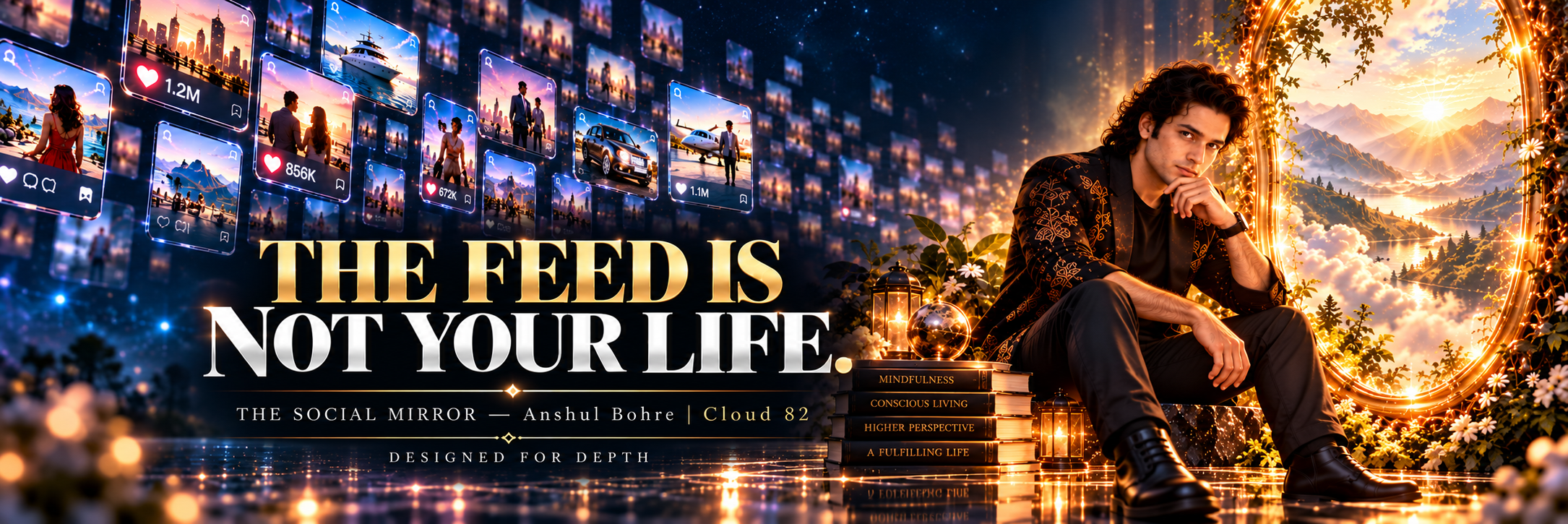
YOUR LIFE IS NOT A FEED
Your life is not a collection of posts.
It is not a follower count, It is not a view count, It is not a verification badge, It is not a trending topic, It is not a profile.
Your life is the conversation you had when nobody was recording.
The person you helped when nobody was watching.
The courage you found when nobody applauded.
The morning you chose hope.
The mistake you learned from.
The relationship you protected.
The dream you continued pursuing without an audience.
The silence in which you finally heard yourself.
These things may never become viral.
They may never receive a million views.
They may never generate engagement.
And yet they may be the most valuable parts of your existence.
THE CLOUD 82 PRINCIPLE
At Cloud 82, we often return to a simple idea:
Designed for Depth.
Perhaps that is exactly what the digital age needs.
Not less technology.
More depth.
Not less connection.
More meaningful connection.
Not fewer voices.
More conscious listening.
Not an escape from the digital world.
A healthier relationship with it.
Because the future of technology should not be measured only by how much more connected humanity becomes.
It should also be measured by whether, in becoming connected to everyone,
we remain connected to ourselves.
So the next time you open your phone, pause for a second.
Before the first scroll, ask:
Why am I here?
To connect, To create, To learn, To contribute?
Or simply to escape the discomfort of being alone with my own thoughts?
There is no shame in any answer.
Awareness is where change begins.
The goal isn’t to leave the digital world.
The goal is to enter it without losing the real one.
Because somewhere beyond the notifications, metrics and endless scroll,
there is still a human being waiting to be present.
And that human being is you.
A NOTE FROM ANSHUL BOHRE
Technology should expand human potential—not quietly replace human presence.
Social media can connect us to the world.
But consciousness must keep us connected to ourselves.
Use the technology.
Don’t surrender your attention to it.
Dream deeper.
Live brighter.
Cloud 82 — Designed for Depth.
— Anshul Bohre
FAQ’S
What is The Social Mirror?
The Social Mirror is a thought-leadership exploration of how social media, digital comparison and curated online identities can influence the way people perceive themselves.
How does social media affect self-worth?
Social media can influence self-worth when people repeatedly compare their own lives with carefully selected images of other people’s success, appearance, relationships or lifestyles. The effect varies between individuals and depends on how platforms are used.
Why do people compare themselves on social media?
People naturally compare themselves with others as a way of understanding their own position, progress and identity. Social platforms intensify this process by presenting a continuous stream of highly curated information.
Is social media inherently harmful?
No. Social media can provide connection, community, creativity, education and opportunities. The concern is less about technology itself and more about unconscious patterns of comparison, validation and excessive attention.
What is social media comparison?
Social media comparison is the process of evaluating one’s own life, appearance, achievements, relationships or circumstances against what other people present online.
Can social media affect identity?
It can influence identity by repeatedly exposing people to particular ideas about success, beauty, popularity, lifestyle and achievement. However, the degree of influence varies considerably from person to person.
What is digital wellbeing?
Digital wellbeing refers to using technology in ways that support a person’s attention, relationships, productivity, mental wellbeing and broader quality of life.
How can I use social media more mindfully?
Useful approaches include becoming aware of emotional reactions while scrolling, questioning unrealistic comparisons, curating what you follow, taking intentional breaks and maintaining meaningful offline relationships and activities.
Should people stop using social media?
Not necessarily. A more useful goal for many people is conscious use rather than complete avoidance—using digital platforms intentionally without allowing them to become the primary measure of identity or self-worth.
What does “Your Life Is Not a Feed” mean?
It means that social media represents selected moments rather than the complete reality of a person’s life. Comparing your entire life with another person’s carefully curated highlights can create an inaccurate perception of your own experience.
What is the central message of The Social Mirror?
The central message is simple:
Use the feed as a tool—but don’t let it become the mirror through which you define yourself.
https://anshulbohre.com/contact
The Social Mirror — Social Media, Self-Worth & Digital Wellbeing
Astral Projection: The Science of Out-of-Body Experiences, Dreams & Consciousness
Dreams, Lucid Dreaming & Parallel Universes: Can Consciousness Travel Across Dimensions?

Humanitarian Governance: Reimagining Democracy for Five Generations
Equinox: The Art of Balance